
The ground beneath Almeria still hasn’t settled, latest data from Spain’s National Geographic Institute (IGN) suggests.
Two weeks after a 5.2-magnitude quake rattled thousands awake just after 7am on July 14, a fresh wave of seismic activity has struck both at land and at sea.
In the last 72 hours alone, five more earthquakes have been recorded in the province, reports the IGN.
READ MORE: Earthquake experts reveal July 14 tremor was close to causing serious damage
While none matched the power of the mid-July jolt, the tremors are part of a persistent pattern that has seen more than 30 earthquakes hit the region in just two weeks, most of them offshore.
Tremors on land: Fondon and Níjar
Two of the most recent quakes were recorded on land. The first hit Fondon, in the Alpujarras, on Thursday night at 9.26pm, registering a magnitude of 1.9 at a shallow depth of six kilometers.
The second shook the municipality of Nijar near Las Negras on Sunday afternoon. It was slightly weaker at 1.8 magnitude but deeper, striking more than 20km below the surface.
Offshore Activity: Alboran Sea sees strongest jolt
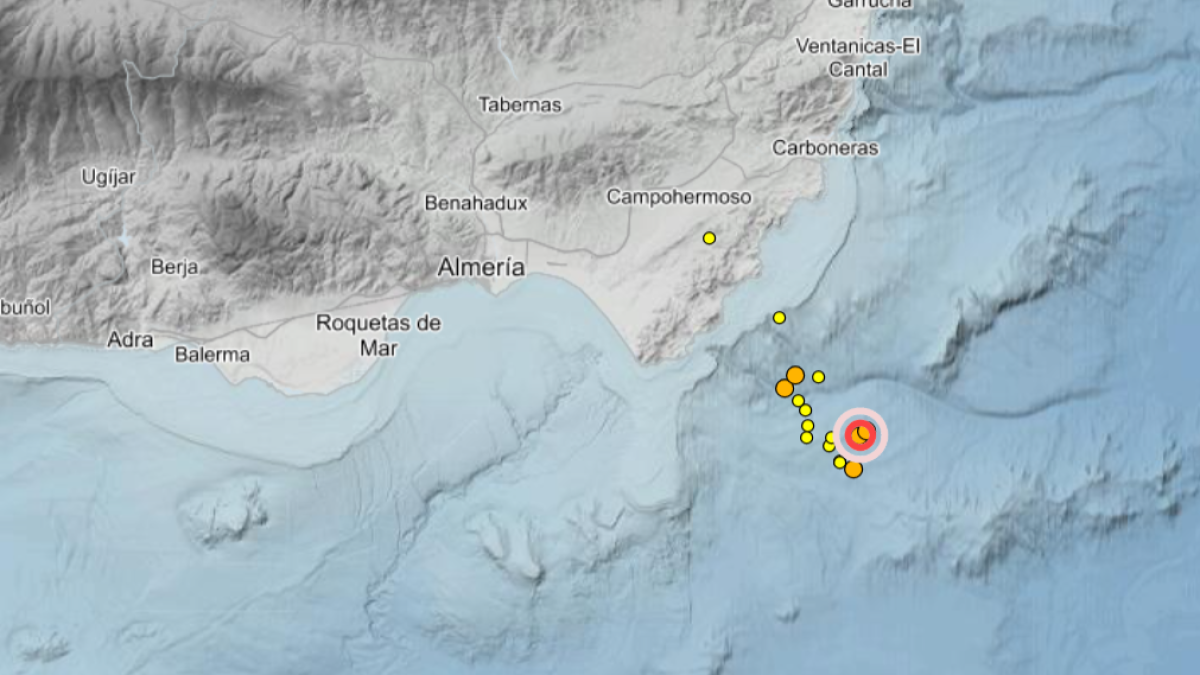
The sea remains the epicenter of most seismic activity. The strongest of the latest quakes hit early Sunday at 4.34am in the Alboran Sea, registering 2.6 on the Richter scale.
Two others were reported off the coast of Nijar – one Thursday at 1.9 magnitude, and another Sunday morning at 1.5.
IGN data shows that this string of offshore tremors continues to cluster around the Mediterranean-Southern Levant zone, just off Cabo de Gata.
Though recent quakes have been minor, the frequency of seismic events is raising eyebrows across the province, particularly after the July 14 quake, which was one of the strongest felt in the region in years.
However, experts have not issued any alerts or warnings, with the activity so far deemed to be within normal levels.
Read more Spain news at the Spanish Eye.