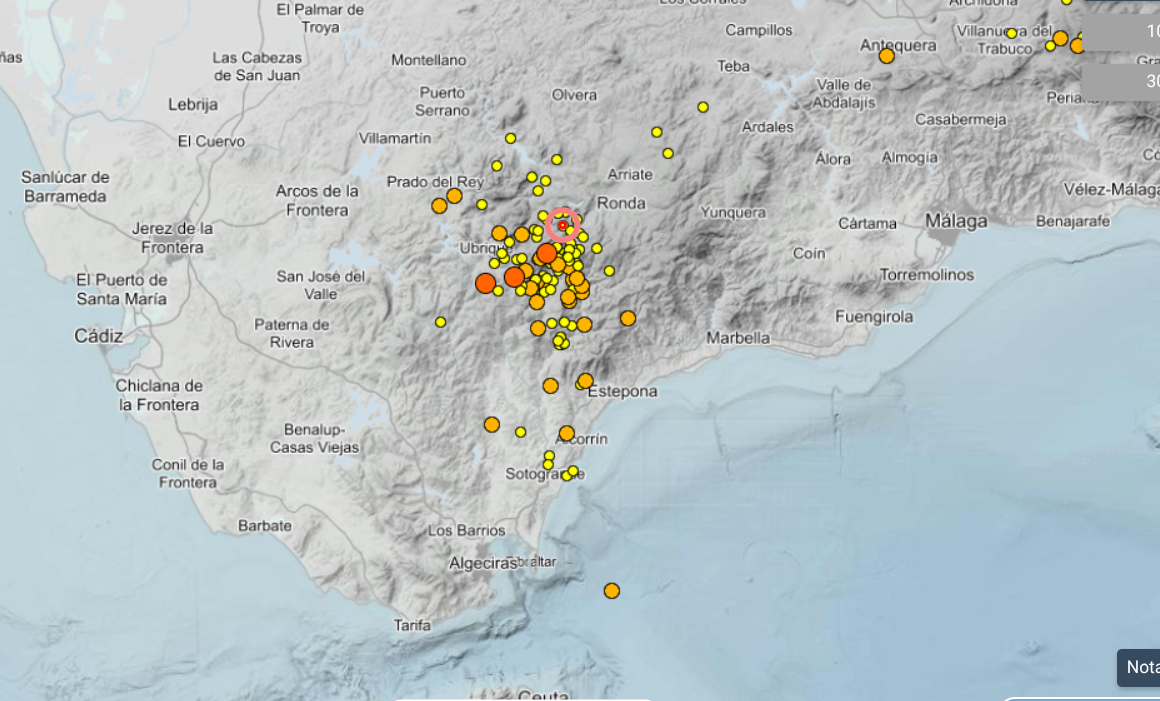

More than 450 earthquakes have been recorded in Malaga and Cadiz over the past week, seismologists have confirmed.
Experts at the Instituto Andaluz de Geofísica y Prevencion de Desastres Sismicos, based at the University of Granada, have confirmed a significant increase in activity.
According to the Andalucian Seismic Network, an uptick was first detected on February 3 and has since stabilised, with up to 456 earthquakes recorded. Of these, 105 measured between 1.2 and 3.5 on the Richter scale.
Where and how strong were the earthquakes?
The tremors, registered between February 3 and 10, were located between the south-west of Malaga province and the south-east of Cadiz province.
All recorded events had magnitudes greater than 0.4 and below 3.5, placing them in the low-to-moderate range.
In recent days, the institute says it has been detecting an average of around 15 earthquakes per day.
Almost 20 of the tremors were felt by residents in towns close to the epicentres.
The strongest so far occurred on February 8 at 1.43am, reaching an intensity of III–IV, according to data from the National Geographic Institute (IGN).
That earthquake was located north-west of Jimera de Líbar, in Malaga province.
Epicentre remains well defined
Experts say the epicentral distribution remains concentrated within a triangle formed by the towns of Benaojan, El Bosque and Casares – an area known for recurrent low-magnitude seismic sequences.
Monitoring stepped up
To monitor the situation, the Andalucian Seismic Network currently operates:
- 25 broadband seismic stations
- 8 short-period stations
- 61 accelerometers across Andalucía
In addition, the IGN has installed three portable seismic stations in the affected area to improve earthquake detection and location accuracy.
These stations are sharing data in real time with the Andalucian Institute of Geophysics, alongside information from other national and international seismic networks.
Experts stress that the activity remains closely monitored and that, while noticeable, the earthquakes recorded so far are not unusual for this tectonically active region of southern Spain.
Read more Andalucia news at the Spanish Eye.