
The danger in Grazalema is not just coming from the sky, it is literally rising up from beneath people’s homes.
After Storm Leonardo dumped more than 600 litres of rain per square metre in less than 24 hours, the ground beneath this white village in Cadiz province has reached breaking point.
The geology of the area explains why the situation has become so serious – and why residents heard loud cracking and ‘explosion-like’ sounds as the earth shifted.
The town was completely evacuated on Thursday, with all residents relocated to Ronda over safety fears.
Here’s what experts at Meteocabra El Tiempo say is happening below the surface.
1. The ‘Swiss cheese’ effect beneath Grazalema
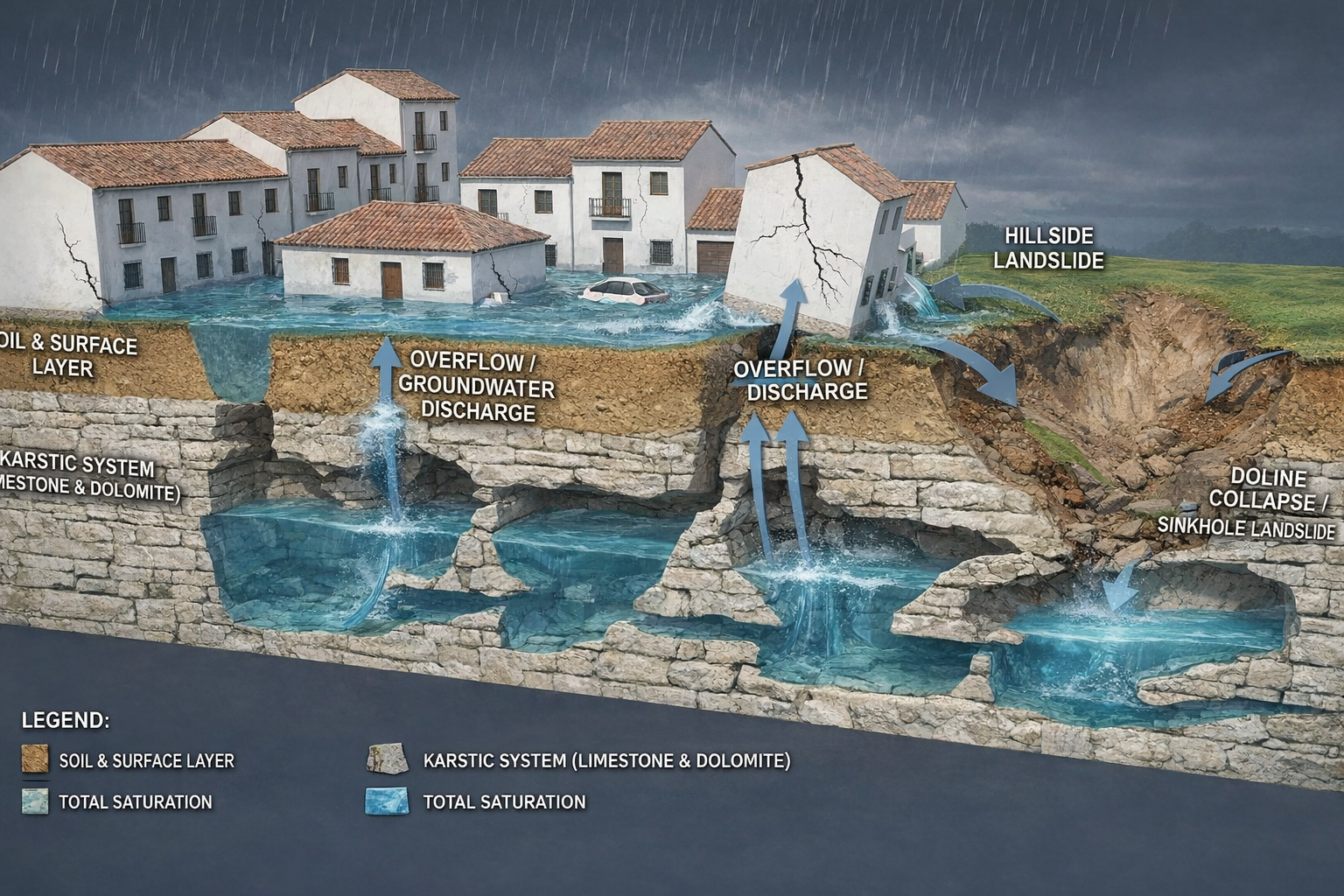
Grazalema sits on a karst landscape, made up of limestone rock riddled with caves, tunnels and underground voids, much like a sponge.
When rainfall is extreme and consistent, as it has been recently, the underground drainage system simply cannot cope and becomes totally saturated.
Once the rock is saturated, water has nowhere to go and is forced back up under pressure, emerging through floors, basements and even walls. Geologists call these pressure release points trop-pleins.
This is why residents have reported water gushing out of walls, sockets and foundations.
2. The three main collapse risks
The threat is not just flooding, but how the water destabilises the ground from within:
Hydrostatic pressure
Water trapped underground pushes upwards with enormous force. Many buildings are not designed to withstand pressure from below, meaning load-bearing walls and foundations can crack or fail suddenly.
Sinkholes (dolines)
As water erodes the rock inside hidden cavities, the ‘roof’ of an underground void can collapse without warning, creating sudden sinkholes beneath streets or homes.
Landslides on slopes
On hillsides, loose soil becomes saturated and turns into liquid mud. Once it loses grip, it can slide downhill, carrying earth – and buildings – with it.
3. Emergency measures: Drilling to save homes
Residents may have noticed holes deliberately drilled into house walls as part of an emergency safety measure.
By allowing trapped water to escape, engineers reduce internal pressure, lowering the risk of walls or foundations blowing out catastrophically.
What happens when the rain stops?
The danger does not end when the weather improves.
As water drains away, the ground slowly readjusts, often triggering differential settlement, where parts of buildings sink unevenly. This is when serious structural cracks typically appear.
For this reason, technicians continue to monitor ground movement, vibrations and subsurface pressure, even after the rain eases.
Read more Andalucia news at the Spanish Eye.