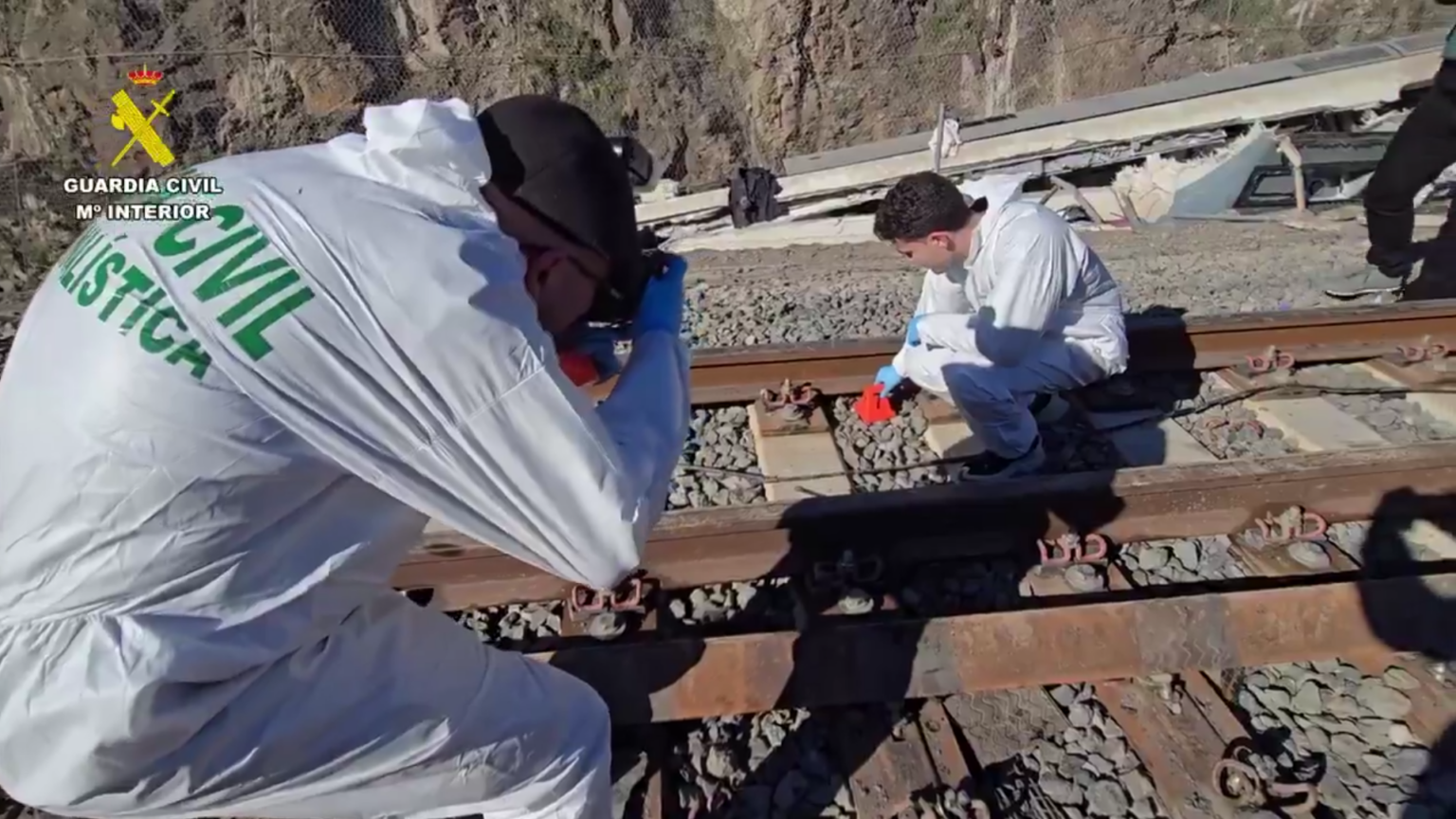

This is the moment Guardia Civil officers were seen inspecting broken joints in the rails at the site of the Cordoba train tragedy on Monday.
It comes as the investigation is pointing to such breaks as being a potential cause of the disaster that has claimed at least 40 lives – while dozens more remain injured in hospital.
Transport Minister Oscar Puente stressed on Monday evening that the probe must now determine whether the breaks were the cause of the deadly incident or merely one of its consequences.
Puente explained that investigators have identified multiple breaks along around 200 metres of track, and that the right-hand side – on which the derailed Iryo train was travelling – showed a ‘very significant break’ at the point where the derailment is believed to have occurred.
In several television interviews on Monday afternoon, the minister reiterated that it is still too early to conclusively link the welding of the track to the derailment of the Iryo train, which later collided with an Alvia service.
Speaking on the programme Malas Lenguas on La 2, Puente said that attributing the accident to a welding fault at this stage is ‘not viable’.
He explained that the crash ‘destroyed part of the infrastructure’, meaning laboratory analysis is now required before any firm conclusions can be reached.
For now, he said, investigators are continuing to gather data and any specific theory remains speculative.
While some reports have pointed to a possible welding failure as the origin of the derailment, Puente acknowledged in another interview on La Sexta that speculation is inevitable, particularly after the Guardia Civil released an image of the section of track under examination.
He confirmed that numerous breaks have been found along a 200–300 metre stretch in the accident area.
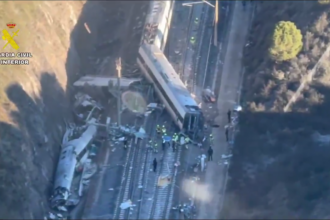
According to the preliminary account from the investigation commission, an Iryo train derailed, causing its last two carriages to spill onto the adjacent track.
Around 20 seconds later, an Alvia train travelling on that line collided with them, leading to the first two Alvia carriages falling down a four-metre embankment.
One key question still to be resolved is whether the break closest to the derailment point was a direct result of the crash or the trigger that caused it.
Puente also highlighted the unusual nature of the derailment, noting that it occurred at the eighth carriage of the Iryo train and on a straight section of track – a scenario he described as ‘extremely rare in railway operations’.
Meanwhile, families continue to search desperately for missing relatives through social media.
As of the latest update, 41 people remain hospitalised, 12 of them – including a minor – in intensive care units.