
The fight against drug trafficking in Andalucia is become increasingly complicated amid a surge in rival clans and ever-changing technology.
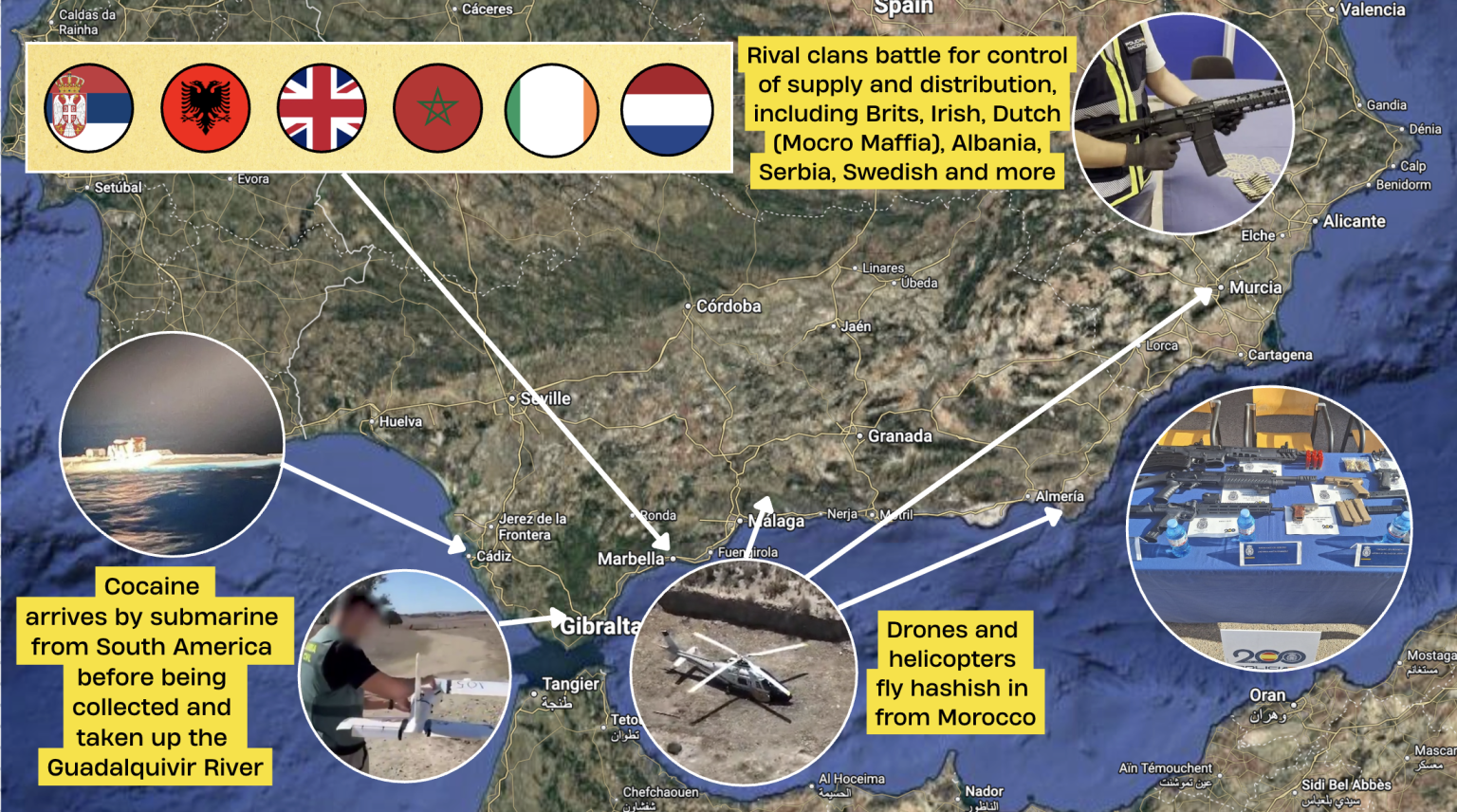
Over the past few years, drug cartels have been employing everything from submarines, drones and helicopters to smuggle narcotics into the region.
Andalucia is the main entry point into Europe for cartels in South America and Africa, making it strategically vital for an industry that continues to make hundreds of billons of dollars each year.
Looking for a piece of the action are more than 100 international criminal networks based along Andalucia’s coast, including the Costa del Sol.
Marilo Valencia, spokeswoman for the Reformist Police Union (SRP), told the Spanish Eye that the string of high-profile shootings this year follows an influx of younger criminals moving to Spain’s costas, not only to run illegal networks but to enjoy the lifestyle.
The Costa del Sol is filled with international, high net-worth individuals who like to splash the cash on yachts, luxury cars and hotels – providing the perfect hiding place for wealthy criminals.
‘While some are here to work, others come to enjoy their money, drive nice cars and luxury hotels, they can blend in with the wealthy crowd,’ Valencia previously told this paper.
She said there are dozens of clans operating along the coast, with each playing their own role in the ‘criminal ecosystem.’
‘The Swedish are known for money laundering and drug trafficking, for example,’ she said.
‘When you’re a criminal coming to operate in Spain you will need logistics, a car that will go undetected, maybe false documents or even weapons, and you will go to the gang who specialises in those trades, and along the Costa del Sol there is a bit of everything.’
The union rep said gangs often work together, unless someone crosses the line, which is when violence can spill onto the street.

‘When someone is assassinated or shot it is usually because they betrayed the leader, owe someone money or it is a settling of accounts between rival groups,’ she explained, adding that hitmen – sometimes teenagers – are increasingly being flown in from abroad to take down rivals.
This year, Swedish rapper Hamko was shot to death in broad daylight on the streets of Puerto Banus, after two Scottish gangland bosses were brutally gunned down at an Irish bar in Fuengirola – allegedly by Liverpudlian Michael Riley, accused of being an ‘exceptional’ hitman.
Valencia warned that more investment is needed into the police forces to help the authorities fight back.
‘The salaries are too low and we need more officers and an update in our equipment and technology,’ she said. ‘Police are under constant pressure and we need to be able to keep up.’
Narco submarines
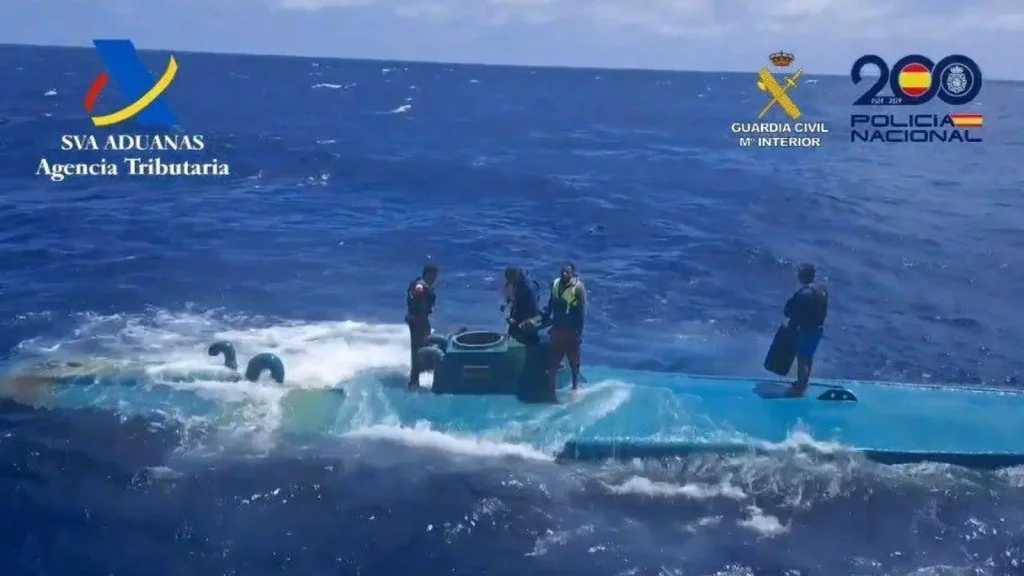
One of the growing technologies used by cartels are narco submarines.
They were first rumbled in 2019, when a semi-submersible carrying three tonnes of cocaine was discovered off the coast of Galicia.
Now, they are operating down south in what has become known as the African cocaine route.
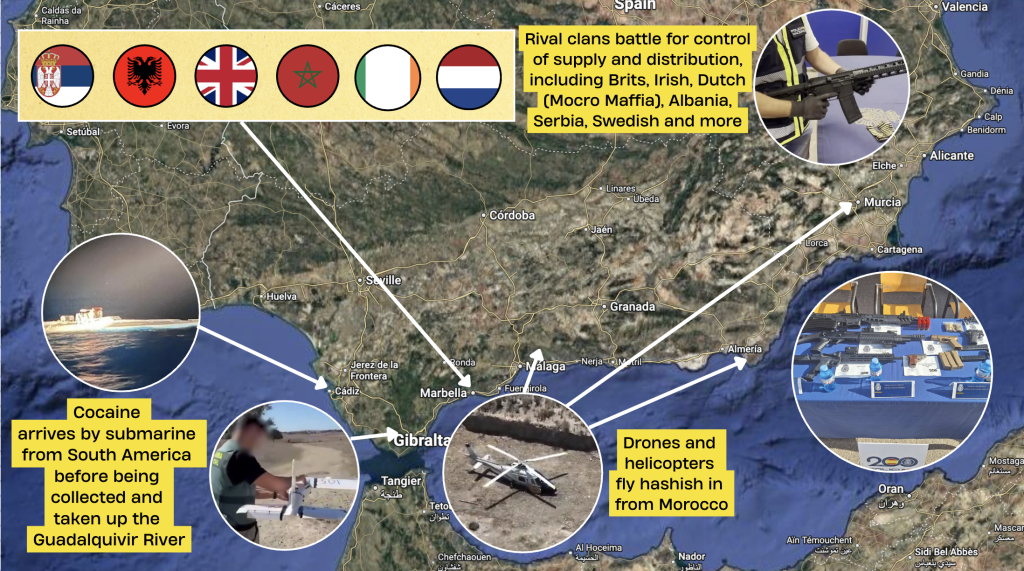
The ‘narco subs’ carry cocaine from South America and stop around 60 miles off the coast of Cadiz, remaining in international waters.
The drugs are then picked up by so-called ‘narcolanchas’, or RHIBs, which are lightweight, high-performance boats that can travel at speed.
The shipments are zipped across the Strait of Gibraltar and into the mouth of the Guadalquivir river, which runs through the heart of Andalucia, including the historic city of Sevilla.
Between December 2024 and January 2025 alone, authorities intercepted 10 tonnes of cocaine in areas near the Guadalquivir, cementing the river as a new entry route for drugs bound for the rest of Europe.
The rubber boats will make the drop off in a secluded spot along the banks of the river.
Last month, a massive international operation led to the interception of a narcosubmarine in the Atlantic Ocean carrying over 1.7 tonnes of cocaine.
The semi-submersible vessel was intercepted by Portugal’s Judicial Police (PJ) and Navy, with key assistance from the UK’s National Crime Agency (NCA), the US Drug Enforcement Administration (DEA), and the Joint Interagency Task Force South (JIATF South).
The submarine, manned by four crew members, was reportedly bound for the Iberian Peninsula, although it is not known whether it was heading to Spain or Portugal.
Police sources this year told Diario de Cadiz that Brazil is the leading manufacturer of the narco submarines, which are sunk to the bottom of the ocean after completing their deliveries.
In Andalucia, once the drugs enter the Guadalquivir River, a ‘guide’ from a local cartel must jump on board and ferry the shipment through the complicated network of channels and streams.
This work, of course, is not done for free, and local drug mafias are now said to be competing for the business.
Reports suggest cartels in the region have intensified their collaboration with drug mafias from across the ocean.
Groups based in the Campo de Gibraltar are constantly changing up their methods of delivery by investing in new technology as part of the endless cat-and-mouse game with the authorities.
Experts from the Policia Nacional and Guardia Civil told Diario de Cadiz that the use of narco-submarines could increase in the coming years, as they are difficult to detect and can carry large shipments at a time.
One said: ‘They’ve realised they can build them ever larger, like the last one they caught near the Azores. They pack tonnes of cocaine, provisions for a week’s sailing, many flasks of fuel, and four or five guys willing to risk their lives for a handful of thousands of euros.
‘They’re just pawns, bad guys with criminal records and little to lose, raised in shantytowns.
‘People without claustrophobia, of course. Capable of going out to take a leak in the middle of the Atlantic… It’s crazy, but it’s the new business niche.’
Russian mafia’s €80,000 drones
Last month, a fleet of high-tech drones which flew drugs from Africa to Spain in the dead of night were also seized by police.
Some 18 long-range drones, which cost €80,000 each, were unearthed during Operation Ruche, led by the Guardia Civil with assistance from the Moroccan Gendarmerie and Europol.
The year-long investigation led to the arrest of nine people, consisting of Latvian, Russian and Ukrainian nationals, as well as Spaniards.

Of the 18 drones seized, eight were operational while 10 were being prepared for drug runs. Authorities also seized €320,000 in cash and 210kg of hashish during five simultaneous raids.
The network’s drones, each worth around €80,000, had a flight range of 200km and could remain airborne for more than two hours.
Although purchased online from China, the traffickers modified them with high-precision equipment in clandestine workshops in Alcala de los Gazules (Cadiz), police said.
The adapted drones were able to take off from the town, fly across the Strait of Gibraltar, collect packages of hashish in northern Morocco, and drop them back into Spain between Tarifa and Vejer de la Frontera, before returning to base.
All flights were carried out at night, weather permitting, with operations often continuing until dawn.
The drones were equipped with GPS guidance systems and visual and acoustic beacons, enabling ground crews using night-vision goggles to quickly locate and retrieve the hashish bundles.
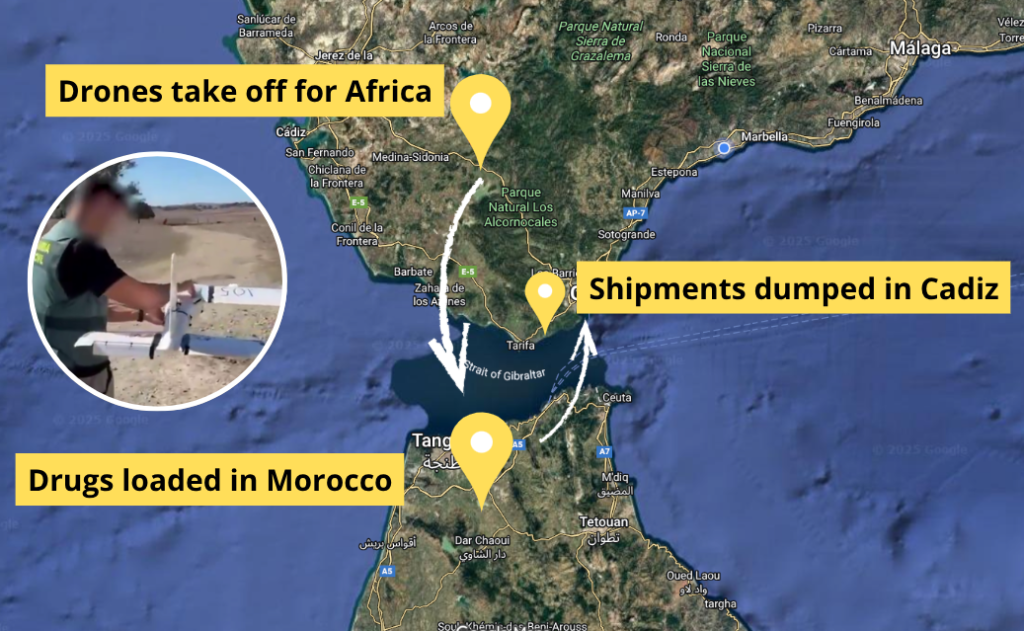
The aircraft themselves were hidden in kitesurfing bags to avoid arousing suspicion.
To store the drugs after recovery, the traffickers rented rural houses for short periods – typically two or three days – frequently changing locations to stay ahead of investigators.
Narco choppers
In the latest discovery this month, a major investigation involving Spanish, Belgian and Swedish police uncovered a drug-trafficking network that used helicopters to smuggle drugs into Spain from Africa.
Authorities arrested six people suspected of using the aircraft to smuggle large quantities of hashish from Morocco to the provinces of Malaga, Almeria and Murcia.
According to the Guardia Civil, the group carried out aerial drug shipments of between 500 and 900kg at a time, flying the cannabis resin across borders before hiding it in industrial units and rural properties and moving it onwards.
The investigation, codenamed Operation Giro, led to the seizure of 657kg of hashish, five firearms and one of the helicopters allegedly used in the smuggling operation.
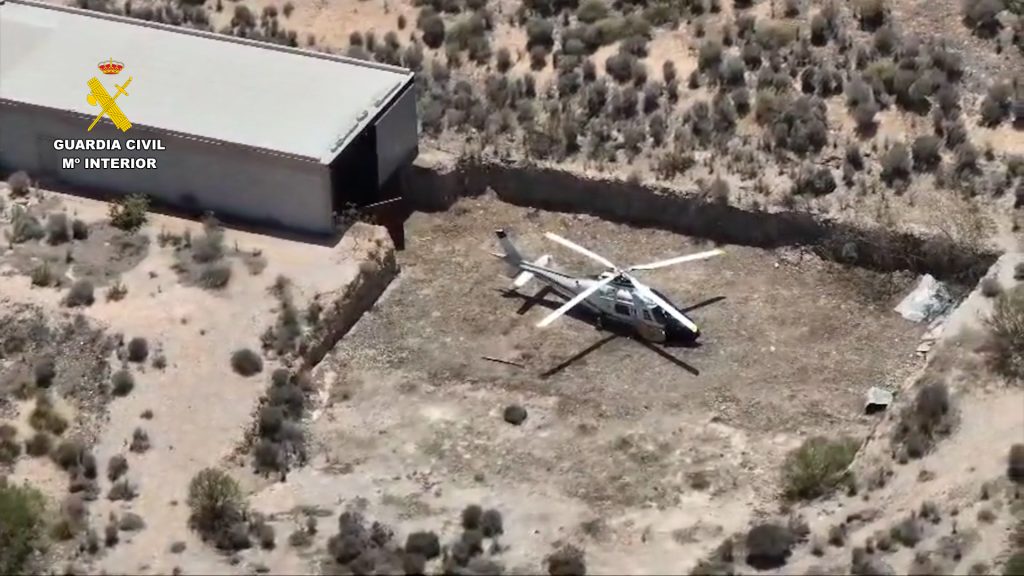
Officers also confiscated cash and several vehicles during coordinated raids across the three provinces.
The case began after investigators noticed suspicious late-night journeys made by several suspects between Malaga and Almeria.
These movements raised concerns of large-scale drug trafficking and were later linked to close cooperation with other individuals organising repeated drug flights from Morocco.
Investigators established that the network used helicopters of different sizes, capable of carrying loads of up to 900kg.
After landing in Spain, the drugs were temporarily stored in warehouses and rural estates before being transported by road to other European countries.
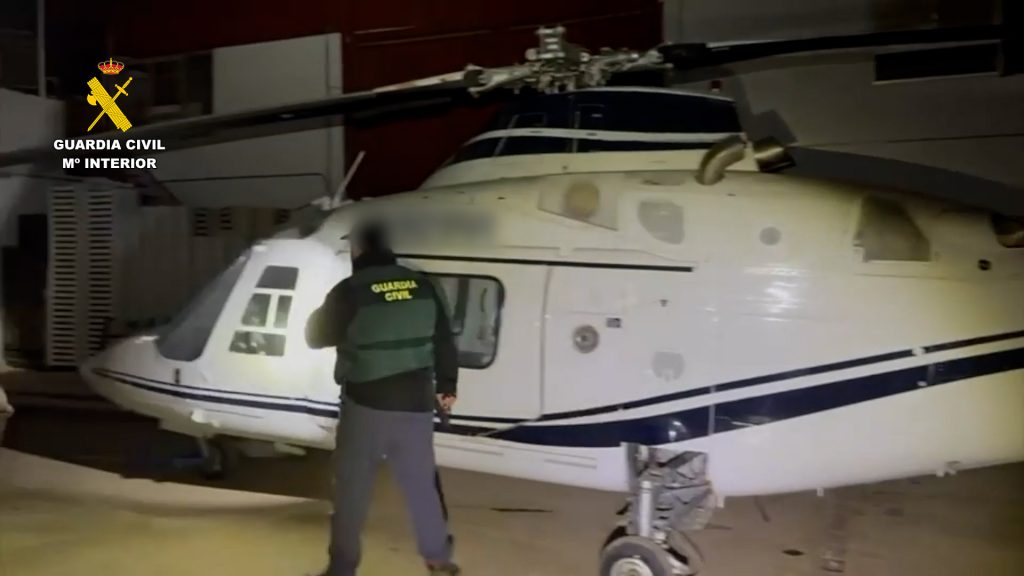
The helicopters reportedly crossed from Morocco and landed in remote areas of Almeria province, where accomplices were waiting to unload the hashish.
The drugs were then taken by van to so-called ‘stash locations’, while the aircraft were concealed in industrial units and rural properties in Almería and Murcia, ready for future operations.
With sufficient evidence gathered, officers searched a property in Nijar, Almeria, where they discovered 25 bales of hashish weighing a total of 657kg.
Five further searches were then carried out in different locations across Malaga, Almeria and Murcia.
These resulted in the seizure of a helicopter, five long firearms, €2,900 in cash and several vehicles, among other items.
All six suspects have been arrested on suspicion of drug trafficking, illegal possession of weapons and belonging to a criminal organisation. They have since been brought before a court.
The operation was led by the Guardia Civil’s judicial police unit in Málaga, with support from the Regional Centre for Drug Trafficking Intelligence (CRAIN), the Central Operational Unit (UCO) and the Rapid Action Group (GAR).
International cooperation also played a role in the investigation, with assistance from Morocco’s Royal Gendarmerie, Belgium’s federal police and the Swedish police.
Read more Costa del Crime news at the Spanish Eye.