A long-discussed rail tunnel beneath the Strait of Gibraltar is technically feasible.
That’s the conclusion of a the latest study commissioned by Spain’s public company Secegsa and carried out by German engineering firm Herrenknecht, a global leader in tunnel-boring technology.
The report concludes that a fixed rail link between Spain and Morocco can be built using current engineering and tunnelling methods, despite the extreme geological challenges beneath the strait.
According to the experts, the first phase of the project – including the construction of an exploratory tunnel – would take between six and nine years, while the most significant milestones are realistically expected between 2035 and 2040.
The total investment required for the Spanish section alone is estimated at more than €8.5 billion, covering the reconnaissance gallery, permanent tunnels, terminals and associated infrastructure.
Challenging geology, but feasible
According to the study, the most complex section lies beneath the Camarinal Sill, an area known for highly demanding geological conditions.
The report analyses how tunnel boring machines (TBMs) could operate in this zone, which includes unstable flysch formations and represents the most technically sensitive part of the route.
The confirmation of technical viability coincides with the Spanish government’s decision to relaunch the project in 2023, following decades of preliminary studies and bilateral cooperation between Spain and Morocco – who are due to share the football World Cup with Portugal in 2030.

Compared with earlier assessments, the Herrenknecht report highlights significant advances in tunnelling technology, while also underlining the scale, cost and logistical difficulty of the undertaking.
Updated preliminary design underway
Following the viability confirmation, Secegsa has tasked state-owned engineering firm Ineco with completing an updated preliminary design of the tunnel, a process originally launched in 2021.
The updated document, known as APP07, is due to be finalised by August 2026 and will represent the first complete revision of the project since 2007.
Ineco’s remit includes the initial design of the reconnaissance gallery, a review of previous studies, and updated assessments of routing, geology, geotechnics, safety, terminals and supporting infrastructure.
Tunnel layout and connections
The proposed route would run for around 65km, with approximately 40km on the Spanish side.
The Spanish terminal would be located in Vejer de la Frontera, connecting to Spain’s national rail network via the Cadiz–Sevilla line through a double-track branch, alongside a single-track link to Algeciras. Road connections to the N-340 and A-48 are also included in the plans.
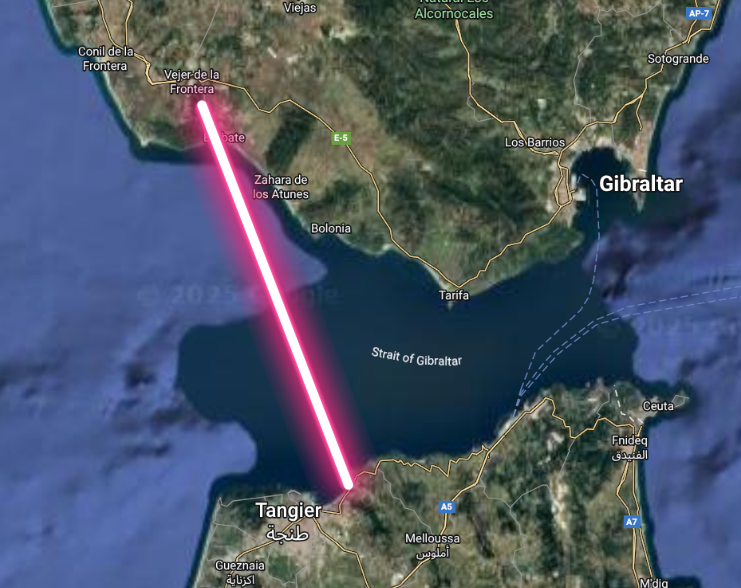
The tunnel would consist of two single-track rail tubes for passengers and freight, plus a service and safety gallery. At its deepest point, it would reach 475 metres below sea level, allowing the 14km sea crossing between Spain and Morocco to be completed in around 30 minutes.
Next steps and funding
Secegsa and its Moroccan counterpart, SNED, are working towards tendering the first exploratory tunnel before 2027. As part of the preparation, technical teams have visited comparable large-scale projects such as Norway’s Rogfast tunnel, which shares similar depth and length characteristics. Parallel studies on seismic activity and seabed conditions are also underway, with input from the US Geological Survey.
The €8.5 billion estimate relates solely to the Spanish section of the project and includes construction, installations and contingency planning.
The government is exploring co-financing options through European funds, alongside additional revenue streams such as rail access charges, logistics services, and potential energy and fibre-optic interconnections.
While early physical works could coincide with the 2030 World Cup, the most realistic timeframe for key stages of the project remains the 2035–2040 window.
The tunnel is designed to create a direct rail connection between Madrid and Rabat, integrating Morocco into the European rail network and significantly boosting the movement of people and goods between the two continents.
Engineers involved in the project describe it as a transformative infrastructure initiative with the potential to reshape mobility, trade and economic development across southern Europe and North Africa.
Read more Andalucia news at the Spanish Eye.