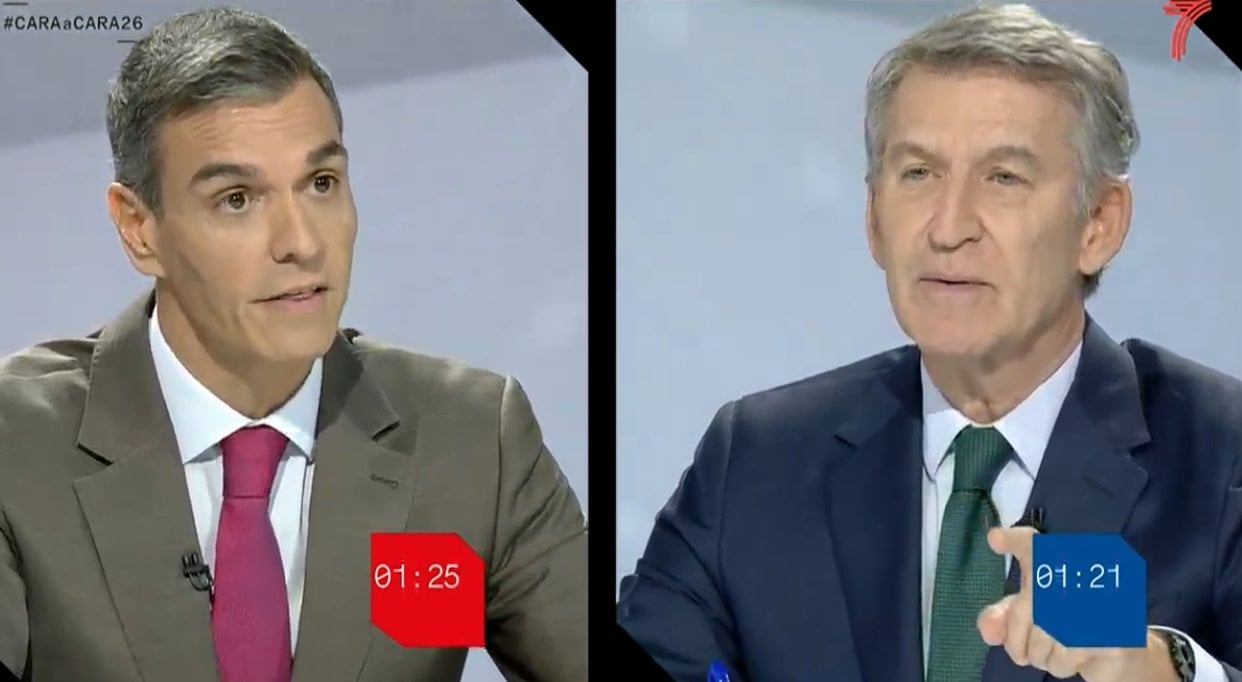

Pedro Sanchez and Alberto Nuñez Feijoo have faced off in a televised debate just 10 days before Spain’s general election.
The prime minister and his conservative challenger clashed on Thursday night over housing, the cost of living and the state of public services, with both promising to raise pensions in line with inflation.
Feijoo opened by listing corruption scandals and attacking Sanchez’s record in office.
Sanchez acknowledged that he had made mistakes and trusted people he should not have, while defending his government’s record on jobs and social rights.
The debate turned personal when Feijoo raised Spain’s two deadly rail crashes and challenged the prime minister over his absence from the state funeral for the victims of the Urda crash.
‘Not a word about trains, Mr Sanchez,’ the Partido Popular leader said during the discussion on public services.
He asked Sanchez how he would have responded if a member of his own family had died in one of the crashes.
Sanchez said he took responsibility, then pointed to the PP’s handling of past disasters, including the Angrois train crash and the Yak-42 air disaster.
The clash came 10 days before the November 29 general election. Feijoo opened the debate by listing corruption scandals and saying Spain deserved a ‘decent’ prime minister.
Sanchez acknowledged making mistakes and trusting people he should not have, while defending his government’s record on social rights and public services.
Build more homes, but how?
Both candidates called for more homes to be built. Feijoo argued that increasing supply would bring prices down and called for tax cuts.
Sanchez said more construction should go hand in hand with regulation, warning that building alone risked fuelling another property bubble.
Sanchez accused PP-led regional governments of failing to use the powers available under Spain’s housing law.
He also criticised the PP for opposing measures in Congress such as aid for young people and limits on tourist lets. Feijoo pointed to rising housing costs during Sanchez’s time in office.
Two offers of a deal on wages and pensions
Sanchez challenged Feijoo to agree to keep the minimum wage at 60% of the average wage. Feijoo countered with a pledge to cut taxes for working people, arguing that having a job no longer guaranteed they could make ends meet.
Both leaders backed raising pensions in line with inflation. Sanchez went further, proposing to enshrine that guarantee in the Constitution.
Feijoo questioned whether the offer was sincere and separately pledged to create a government office dedicated to older people.
The economic debate exposed a divide in what each leader chose to emphasise. Sanchez cited European Commission forecasts for growth and job creation, while Feijoo focused on rising food prices and the squeeze on household budgets.
Sanchez argued that higher taxes on large companies and fortunes would help fund public services, and warned that a PP government backed by Vox would cut them.