
Drivers planning to travel around Andalucia or Spain in a motorhome or campervan this year should take note of new rules just introduced by Spain’s traffic authority.
The Direccion General de Trafico (DGT) has published updated regulations under Instruction PROT 2026/04, bringing in changes that affect inspections, parking rules and signage for caravans and camper-style vehicles.
The update replaces the previous 2023 guidance and reflects the rapid growth in motorhome travel across Spain in recent years.
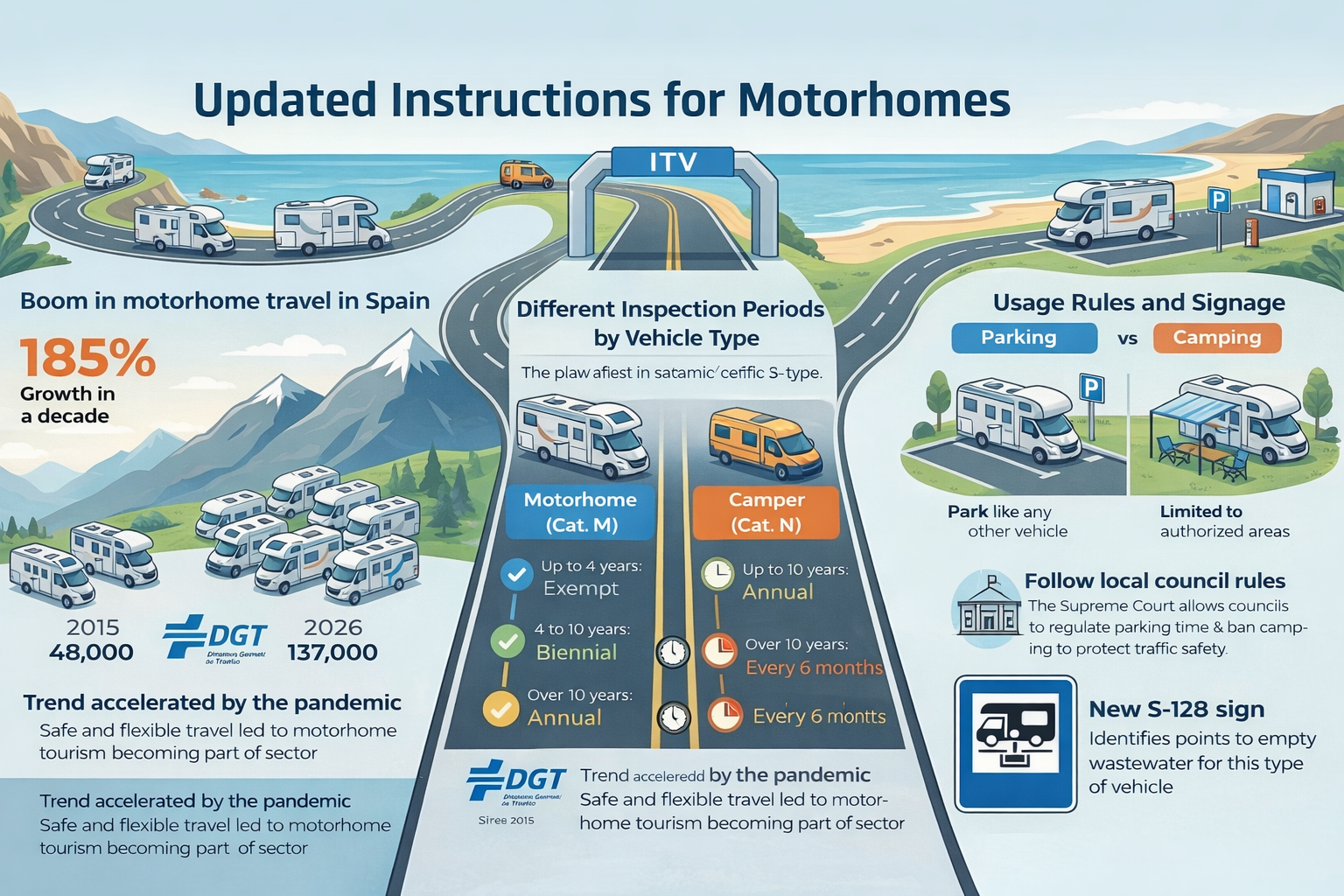
New ITV rules depending on vehicle type
One of the biggest changes affects how often vehicles must pass their ITV (roadworthiness test), with different rules depending on the category.
Motorhomes classified as category M will now be:
- Exempt from ITV for the first 4 years
- Tested every two years between 4 and 10 years old
- Tested annually once they are over 10 years old
Campervans and converted vans (category N) face stricter checks:
- Annual ITV inspections up to 10 years old
- Every six months once they pass the 10-year mark
Parking rules clarified in towns and cities
The new instruction also makes it clear that motorhomes can stop and park under the same conditions as any other vehicle.
However, there is an important catch.
Local councils still have the power to set their own rules through municipal bylaws. This means they can limit how long vehicles can stay parked and ban camping outside authorised areas.
These powers have been backed by Spain’s Supreme Court, particularly to protect road safety, traffic flow and fair use of public parking spaces.
In simple terms, parking is allowed, but setting up camp is often not.
New signage for motorhome services
The update also introduces clearer signage to support the growing number of motorhome users.
A new road sign, known as S-128, will mark official points where vehicles can empty wastewater, helping improve infrastructure for this type of travel.
Boom in motorhome travel
The rule changes come as motorhome use continues to surge across Spain.
Since 2015, the number of these vehicles has nearly tripled, rising from just over 48,000 to almost 137,000 in 2026.
The trend accelerated during the Covid-19 pandemic, when many travellers looked for safer, more flexible ways to explore.
What started as a temporary shift has now become a lasting travel style, with motorhomes and campervans firmly established as a key part of Spain’s tourism landscape.
Read more Andalucia news at the Spanish Eye.