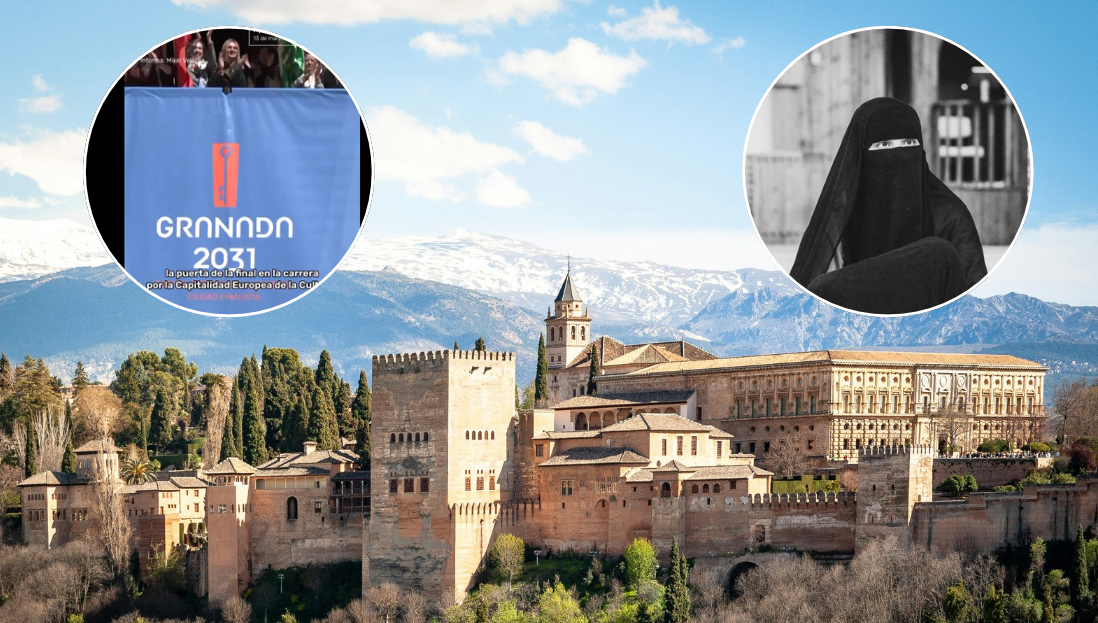

Granada has passed the first major hurdle in its bid to become European Capital of Culture in 2031, after being named among the finalist cities in Spain’s selection process.
The announcement was made on Friday during a press conference at Spain’s Ministry of Culture, where the shortlist of Spanish candidates continuing in the competition was revealed.
Alongside Granada, the cities of Caceres, Las Palmas de Gran Canaria and Oviedo remain in the race.
The news comes just days after Granada’s city council approved a controversial measure banning face-covering garments such as the burka or niqab from municipal buildings, a decision that sparked debate both locally and nationally.
Granada’s most iconic monument, the Alhambra Palace – often the most visited site in Spain each year – was built under Islamic rule.
Much of the ancient citadel’s beauty derives from the Al-Andalus period, when Arab kingdoms ruled over southern Spain.
It is not immediately clear if the controversial ban on the traditional Islamic attire, which many have labelled ‘divisive’, could hurt Granada’s chances of winning the Culture Capital title.
International jury announcement
The shortlist was confirmed by Tanja Mlaker, president of the international panel of experts overseeing the selection process.
She explained that a detailed report outlining the jury’s assessment of each candidate will be published within the next month.
Granada’s mayor, Marifran Carazo of the Partido Popular (PP), said the city’s bid team will analyse the report and introduce new elements to strengthen the proposal in the coming weeks.
Carazo made her first remarks to the media before joining members of the city’s delegation and the consortium leading the bid on the balcony of Granada City Hall in Plaza del Carmen, where supporters gathered to celebrate the announcement.
Inside the council chamber, members of the Granada delegation followed the press conference live, visibly nervous as the jury spokesperson worked through the list before revealing the final verdict.
Institutional backing and regional collaboration
The mayor also encouraged the other Andalusian city that had entered the competition, Jerez de la Frontera – which did not make the shortlist – to collaborate with Granada as the final phase of the process begins.
She congratulated the other finalist cities and those that did not advance, praising their ‘brave commitment’ to placing culture at the centre of urban transformation.
‘We have defended a rigorous, solid and deeply vibrant proposal,’ Carazo said. ‘We have explained clearly what kind of city we want to be and how culture can help us build a Granada that is more open, creative and connected to Europe.
‘Behind this project there is talent, hard work and, above all, a shared enthusiasm from thousands of people. That is what keeps us moving forward.’
Broad social participation
City officials highlighted the wide social involvement behind the bid, which has brought together the University of Granada, research centres from Spain’s National Research Council (CSIC), cultural associations, citizen groups, businesses and professionals from the creative sector.
The project has been designed as a true ‘city-wide initiative’, aiming to combine Granada’s cultural heritage with its European outlook and its ability to engage with other cities across the continent.
Granada’s proposal also emphasises sustainability, European values and the challenges facing modern urban societies.
The Granada 2031 plan includes the creation of new cultural innovation spaces, the restoration of historic sites for cultural use and the development of infrastructure aimed at strengthening the city’s creative ecosystem.
It also seeks to reinforce Granada’s reputation as a major cultural hub through its festivals and the revival and expansion of cultural initiatives that help project the city internationally.
Spain and Malta will host the European Capitals of Culture in 2031. The selection process begins six years in advance, with the final designation typically confirmed four years before the title year.
Granada will now compete with the remaining finalist cities as the process enters its final stage, with the winning Spanish city expected to be announced later this year.
Read more Andalucia news at the Spanish Eye.