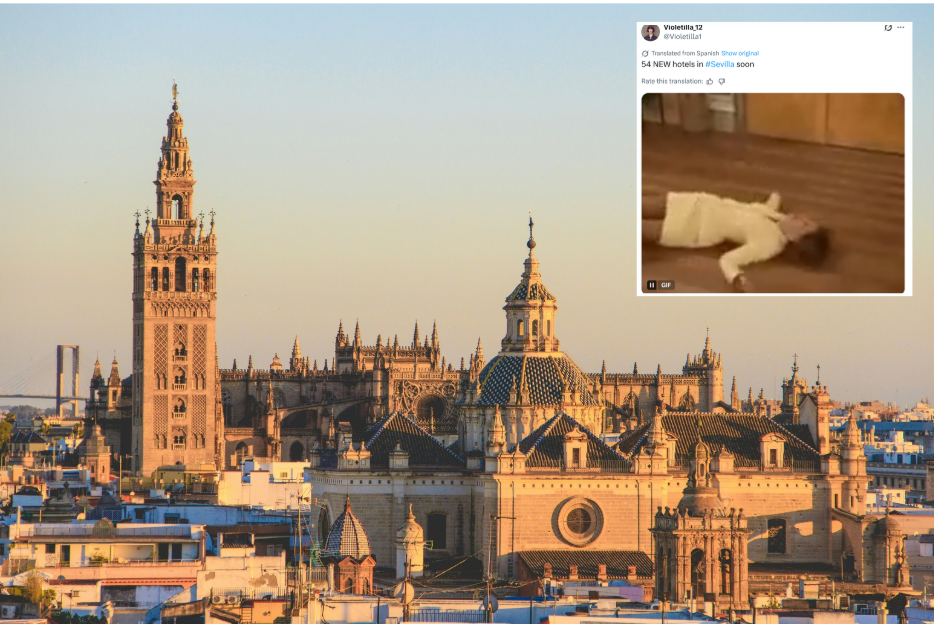

Sevilla is set for a major tourism expansion, with 54 new hotels and tourist accommodation projects planned in the medium term, it has emerged.
Ten of the projects are five-star developments, in a move that will reshape the city’s urban, economic and professional landscape – but not everyone is happy.
Locals reacting to the news on social media said they are being ‘forced out’ from the Andalucian capital.
It comes as venture firms continue to buy entire buildings to convert into tourist flats, as it allows them to skirt the ban on new holiday apartments in saturated areas.
One local fumed on X: ’54 new hotels and dozens of entire residential buildings being converted into tourist apartments.
‘In the midst of the biggest housing crisis in history, the mayor and Juanma Moreno are forcing us out of Sevilla so they and four crony businessmen can line their own pockets.’
International luxury giants including Four Seasons, Marriott and Hilton have already set their sights on the Andalucian capital, launching projects that will further cement Sevilla’s growing high-end hotel offering.
The developments were discussed at the conference ‘The Province of Sevilla and the Challenge of 54 New Hotels‘, organised by Gaesco and the Official College of Technical Architecture of Sevilla.
Can Sevilla handle more tourism?
Helena Ruiz, president of the College of Technical Architecture, acknowledged the scale of the transformation.
‘Tourism is growing significantly and will have a major impact on the urban, economic and professional environment,’ she said, adding that the city must carefully consider ‘the model of coexistence’ as hotel capacity expands.
Manuel Cornax, president of the Association of Hotels of Sevilla and Province, insisted the city can absorb more tourism if managed correctly.
He stressed the importance of controlling visitor flows, pointing to new digital tools being developed by Seville City Council to monitor overcrowding in real time.
‘We have to grow, but sustainably and socially responsibly,’ he said.
Setbacks: rail chaos and global tensions
Despite the ambitious outlook, 2026 has already proven difficult for the sector.
Railway disruptions affecting Andalucia earlier this year caused hotel occupancy in Sevilla to drop by 12%, according to Cornax. International geopolitical instability is also creating uncertainty.
Visitors from Asia – particularly Japan, China, South Korea and Indonesia – are considered highly valuable due to higher spending levels. However, ongoing regional tensions are disrupting air routes.
‘Right now there are 19,000 flights halted in Doha. We don’t know how long this will last,’ Cornax warned, referencing key Gulf transit hubs such as Kuwait, the UAE and Dubai.
Even so, he remains optimistic: ‘We have one of the most cutting-edge hotel offerings in Spain – perhaps even in Europe.’
A prime real estate investment
Industry leaders say Sevilla’s appeal goes beyond its historic heritage.
Cultural assets such as opera, theatre, the Royal Symphony Orchestra of Sevilla (ROSS), equestrian traditions and bullfighting – alongside modern events like the Icónica Festival – are strengthening its international brand.
Add to that strong public safety, healthcare standards and gastronomy, and Sevilla has become increasingly attractive to international investment funds.
‘It’s considered a solid real estate investment. People feel safe here,’ Cornax said.
Strengths and warning signs
Eduardo Serrano, director of hotel consultancy ESMA, outlined the sector’s advantages:
- Growing internationalisation
- Strong connectivity
- High profitability
- Quality employment
- Expansion into luxury positioning
- Territorial growth beyond the historic centre
However, he also flagged risks:
- Signs of market stagnation
- Declining domestic tourism
- Short average stays
- Public transport deficits
- Pressure on housing and historic areas
Angel Lahera, hotel project manager at Fuerte Group, stressed that expansion must not come at the expense of standards.
‘It’s not just about growing, it’s about building with quality,’ he said.
He added that integrating tourists into city life – and vice versa – will be essential to avoid social tensions.
However there is already growing backlash locally, with activist groups like Sevilla Se Muere (Sevilla Is Dying) and Sevilla Resiste becoming increasingly popular.
When the news of 54 new hotels first emerged in late December, the Sevilla Se Muere group accused Sevilla city council of ‘spitting in our faces’.
Read more Andalucia news at the Spanish Eye.