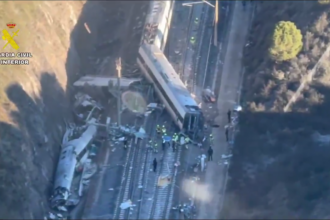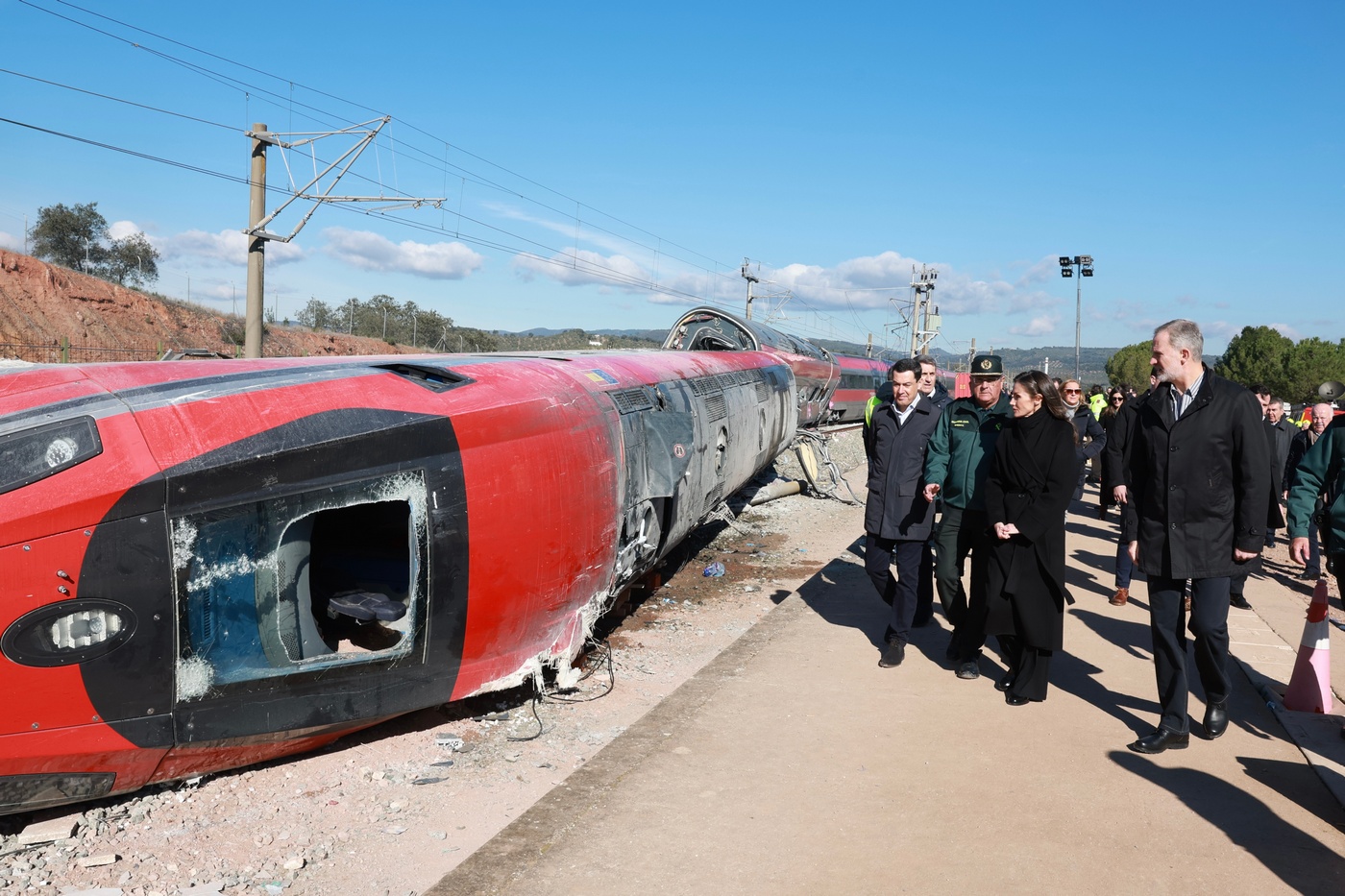

Initial findings from the Adamuz train disaster probe point to a broken piece of rail being behind the fatal derailment.
In a statement released on Friday, the Comision de Investigacion de Accidentes Ferroviarios (CIAF) said that when the sixth carriage of the Iryo train left the track, there was effectively no rail left beneath it.
According to investigators, the rail had fractured before the Iryo train passed, meaning the wheel no longer had a continuous surface to run on.
This caused the rear of the Iryo train to derail, before it collided with the front of a Renfe Alvia service heading in the opposite direction, triggering one of the deadliest rail accidents in recent Spanish history.
The CIAF report reveals clear marks consistent with the fractured rail were found not only on Iryo carriages one to five, but also on another Renfe train and two earlier Iryo services that had passed over the same stretch of track between 5.21pm and 7.09pm on January 18, the day of the crash.
‘These marks are consistent with the rail already being in the process of overturning outwards,’ the commission said, adding that the fact that the damage appears on carriage five – while carriage six was the first to derail – supports the theory that the rail was progressively failing as trains continued to pass over it.
‘The derailment of carriage six is compatible with a complete loss of rolling continuity,’ the CIAF said, meaning the train was effectively running over empty space at the point it left the track.
The findings raise serious questions about track monitoring, inspection and response times, particularly given that multiple trains appear to have passed over the damaged rail before the fatal derailment occurred.
The CIAF stressed that these conclusions form part of the early phase of the investigation, with further technical analysis still ongoing.
More detailed findings are expected to be released as investigators continue to reconstruct the sequence of events leading up to the collision.