Visitors walking into the Palacio de Villardompardo might assume they are stepping into yet another grand Andalucian residence from the Renaissance period.
Few realise that beneath its floors lies a far older structure, and one of the most complete surviving examples of an Islamic hammam anywhere in Europe.
The Baños Arabes de Jaen, built in the 11th century, are today recognised as the largest and best-preserved Arab baths in Europe, a status that has earned them designation as a National Monument.
Unlike many Islamic buildings that were destroyed or radically altered after the Christian reconquest, the baths in Jaen survived thanks to an architectural accident.
Rather than being demolished, they were gradually absorbed into later buildings, eventually disappearing completely from view.
When the palace was constructed in the late 1500s, its foundations sealed the medieval baths below ground level. That decision, made with no intention of preservation, would later prove crucial, as the structure remained largely intact for centuries, protected from both weather and urban development.
In Al-Andalus, hammams were far more than places to wash. They functioned as community hubs, used for ritual purification, socialising and relaxation.
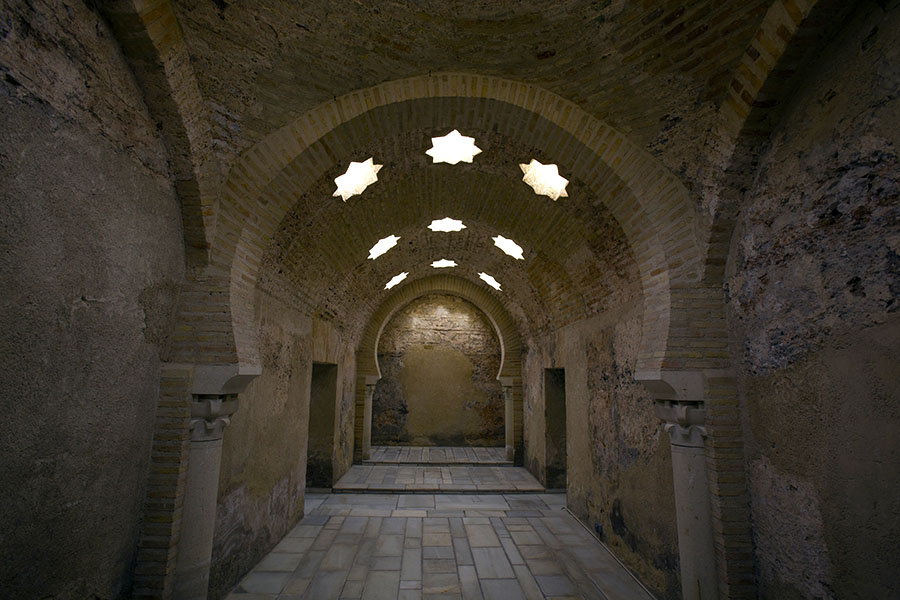
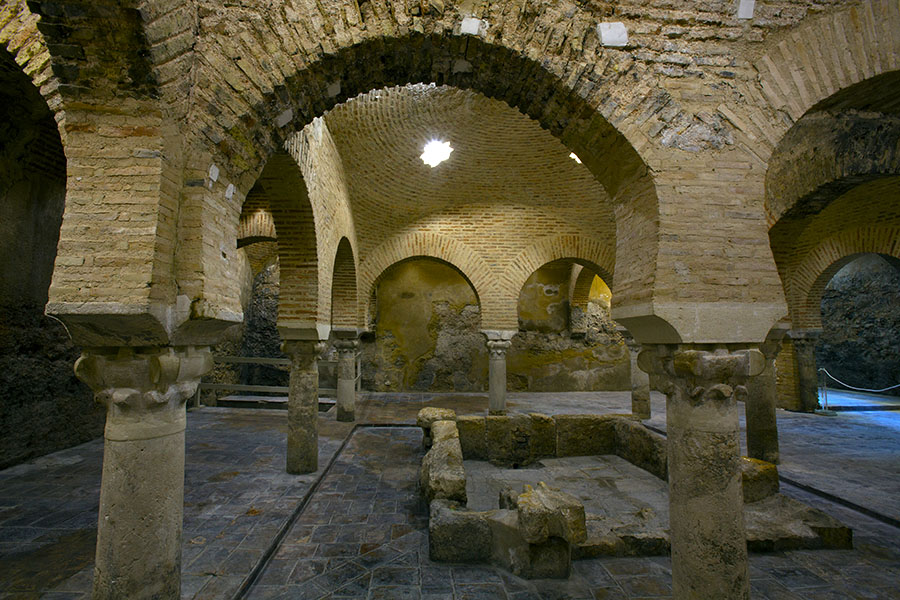
The Jaen complex followed the classic sequence of cold, warm and hot rooms, allowing bathers to move gradually through different temperatures – a system inherited from Roman bathhouses and still mirrored in modern spas.
Covering roughly 450 square metres, the scale of the Jaen baths sets them apart from most surviving hammams in Spain, many of which exist only in fragments.
After the baths fell out of use in the 13th century, parts of the complex were repurposed as tanneries during the late Middle Ages. Evidence of this industrial phase remains visible today, particularly in the warm and hot rooms.
It was only in the 20th century, during work on the palace, that the baths were properly identified and studied. Archaeologists quickly realised their exceptional condition, prompting restoration and official protection.
Today, the baths form part of a wider cultural complex within the palace, alongside the Museum of Arts and Popular Customs and the Naïf Art Museum. Visitors descend below ground level to explore the vaulted chambers, punctuated by star-shaped skylights that once regulated light and steam.