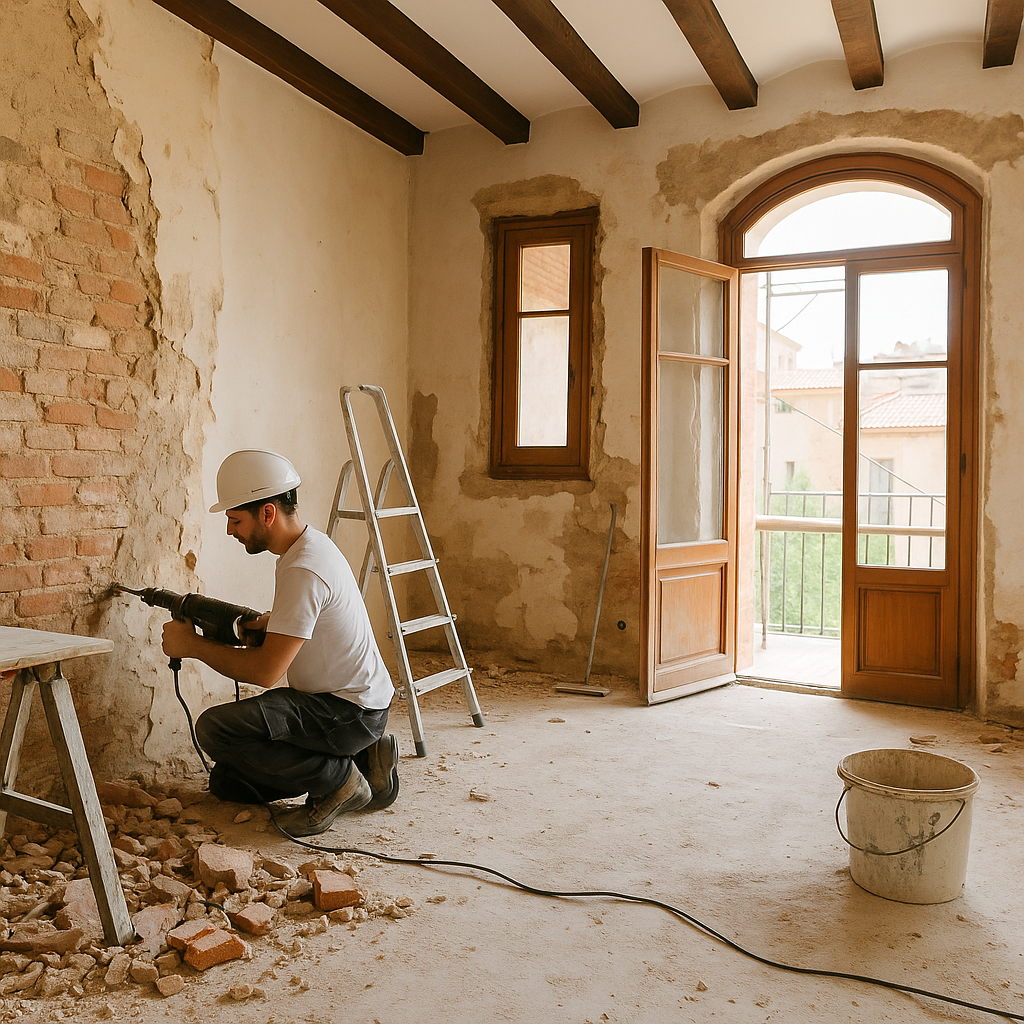

The trend of so-called house flipping in Spain continues to grow, with investors making returns of up to 50%.
It comes as left-wing parties are calling for a tax on profits made from the activity.
House flipping consists of buying a run-down property, performing an extensive renovation and selling it on for a profit.
Valencian party Compromis and Sumar recently proposed a 25% levy on said profits.
According to Compromis, such operations are a form of speculation, and speculators should contribute more in a market where housing is a constitutional right.
MP Alberto Ibañez said those who ‘play Monopoly by buying and selling to speculate on a fundamental right’ should face a 25% tax so they ‘think twice before treating housing like a game’.
He highlighted case studies such as buying a property for €500,000 and reselling it shortly after for €750,000 as evidence that higher taxes are justified.
According to the National Federation of Real Estate Associations (FAI), the average age of Spain’s second-hand housing stock is now 43.5 years, creating fertile ground for opportunistic renovations.
Idealista describes flipping as buying a run-down home at a discount, giving it a full overhaul, and returning it to the market with a ‘second life’.
The platform argues that ‘everyone wins’, as investors recover their outlay with room to spare, and the market gains a newly habitable property without demolishing an older structure.
Ferran Font, research director at pisos.com, added that Spain is particularly ripe for this model.
He told 20Minutos: ‘The housing stock is highly obsolete and needs renovation, not only for habitability but to comply with Europe’s new energy-efficiency requirements.’
Experts say the key to success lies in spotting homes that require major work but whose structure remains sound.
Properties in poor internal condition typically allow buyers to negotiate hefty discounts, boosting eventual margins once the works are complete.
Property Partners, network specialising in high-end residential and commercial real estate, estimates that renovated flips completed within six to eight months are now generating returns of between 20% and 50%, and that the trend is becoming a ‘consolidated segment’ of the residential market.
Felipe Reuse, the company’s Spain director, cautioned that flipping must be approached with responsibility.
He said: ‘It’s a valid tool for regenerating disused assets, but it requires a technical, ethical and sustainable mindset.
‘This isn’t just a resale operation, it impacts urban quality and access to housing.’
But now everyone is convinced. With Spain facing an acute housing shortage, consumer advocates argue that flipping is worsening affordability.
The national consumer federation CECU warns that ‘renovating only to resell at a higher price is also a form of speculation, which does not necessarily improve accessibility.’
The debate has now reached the halls of Congress. Valencian party Compromís has proposed a 25% tax on profits generated by house-flipping operations.
For now, a national tax on house flipping is on the back burner, after a bill that included the measure failed to get enough votes in parliament last month.
Read more Spain news at the Spanish Eye.