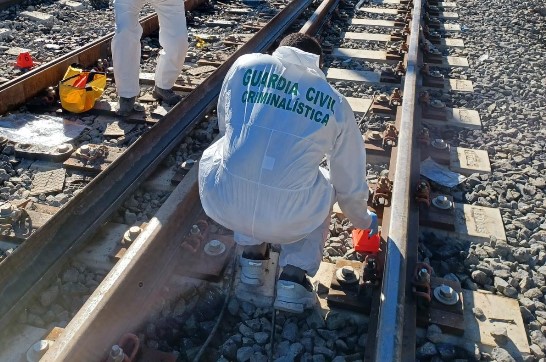

Spain will have to inspect train tracks across the country after a manufacturing defect was revealed as a possible cause of last Sunday’s deadly Adamuz disaster.
Transport Minister Oscar Puente said in a press conference that he has already ordered checks on every piece of rail that came from the same batch as the affected stretch in Cordoba.
Speaking alongside the president of Adif, Luis Pedro Marco de la Peña, Puente insisted that the rail supplier, ArcelorMittal, is a top-tier company that produces almost all of Spain’s rail lines, and does so within Spain itself.
Marco de la Peña also struck a cautious note. He said that if the investigation were to identify any responsibility, Adif’s legal team would decide what steps to take.
For now, though, he warned against jumping the gun, saying that everything remains a hypothesis.
It comes after a preliminary report from the Railway Accident Investigation Commission this week concluded that the rail was already broken when the Iryo train passed over it shortly before derailing.
With that in mind, the Adif president explained that the minister has instructed him to track down every batch of the same type of rail and carry out especially detailed checks.
‘We can do this because we have full data traceability for each component,’ he said.
He also addressed how the rails are welded. That work is carried out by Redalsa, a firm in which Adif holds a 51% stake.
Marco de la Peña described it as a benchmark company in rail welding and the production of long rail sections.
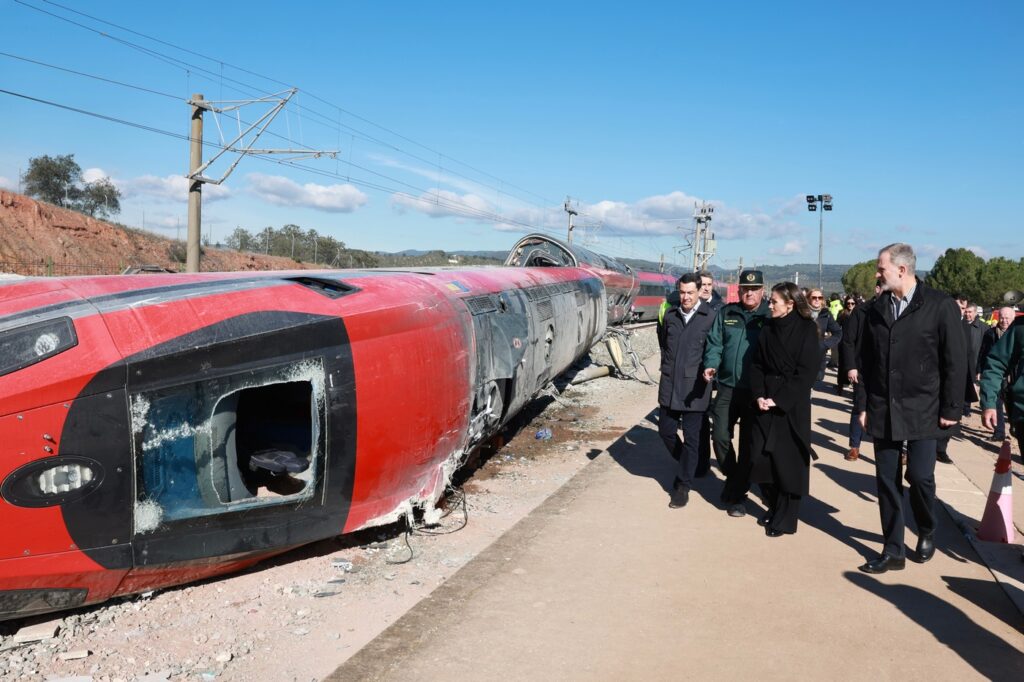
The welds, he added, were inspected twice: first through a full review of every weld on that stretch of track, and then through a second check using a random 30% sample.
As for the renovation works in the Adamuz section, Puente referred to the joint venture awarded the contracts. It brings together Ferrovial, OHLA, FCC and Azvi.
Asked whether these companies can be trusted, Puente was blunt.
‘They are the very best in Spanish public works,’ he said. ‘If we don’t trust the best, then I honestly don’t know who we’re supposed to trust. So yes, there is confidence in them, both in Spain and abroad.’
Puente also defended the inspection regime after the line was renovated.
According to the minister, the Adamuz section was subjected to more checks than usual. All quality certificates were issued, and no train drivers reported problems linked to the infrastructure.
He added that the monitoring and prevention systems designed to detect faults never came close to triggering an alarm.
To back this up, he cited inspection records, certification dates, screenshots from the monitoring systems showing the signals sent by trains, and the four alerts raised by drivers on that line over the past four months.
None of them, he said, had anything to do with the track itself.