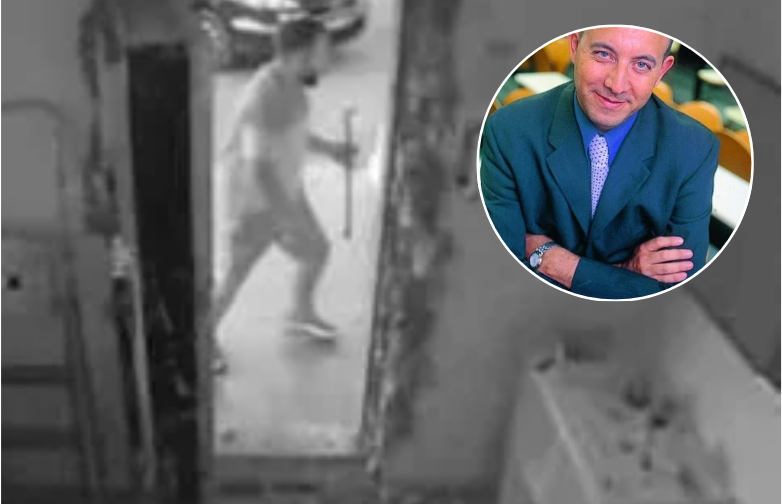

A leading Spanish economist has blasted his country’s justice system when it comes to the scourge of squatters.
Professor Gonzalo Bernardos took to his account on X to list the five ways that ‘okupas’ and ‘inquiokupas’ (tenants who stop paying rent), are favoured by the system.
‘Foreigners are shocked that in Spain squatters have more rights than property owners,’ he said.
‘In most European countries, squatters are out on the street within a month. In Spain, if they appeal the court’s ruling, it can take the owner nearly two years to evict them.’
One of the most abused laws – and the top of Bernardos’s list – is the ban on evicting people who have been declared ‘vulnerable’ by local authorities.
Introduced to protect the weakest in society, the measure, unfortunately, has seen scores of squatters declared vulnerable for invented ailments.
The Spanish Eye knows of one case in which a Dutchman in Estepona stopped paying rent to an Irish couple for years in a stunning villa while driving a Bentley.
He was granted ‘vulnerable’ status due to his ‘alcoholism’. Tragically, the couple were forced to sell the property at a much-reduced value.
Another issue, says Bernardos, is the fact that owners are forbidden by law from cutting off water, gas or electricity if their homes are occupied illegally.
It means squatters are allowed to keep using the property and have no incentive to leave, while the owner must continue paying the bills.
However, there is a bill currently making its way through Spanish Parliament, presented by the People’s Party (PP), to change this law and make it legal to cut off amenities for occupied homes.
Thirdly, landlords are obliged to declare income from their rental property on their income tax return, even if they don’t receive it. This has been confirmed by the Central Economic-Administrative Court (TEAC).
It’s just another example of the Spanish tax system that is often criticised for being ‘punitive’ and ‘anti-business’.
Bernardos also criticised the fact that police will not remove squatters if the home is not the owner’s primary residence, leaving it instead to the courts.
This was recently confirmed by Santiago Thomas de Carranza, managing partner of the law firm Thomas de Carranza Abogado, in an interview with idealista. He warned that a squatter can register as living at the property with a simple pizza delivery receipt.
Finally, and often the most painful, property owners are forbidden from accessing their own home once it is inhabited by squatters.
One of the most viral cases involved a family in Girona who had to return their home to the squatters after they regained possession while they were out.
Spain’s squatter problem is increasingly grabbing headlines around the world, spelling trouble for estate agents trying to sell homes in holiday hotspots like the Costa del Sol.
One agent told the Spanish Eye: ‘I’ve had clients pull out of deals after hearing about the squatter problem.
‘They want to invest in property and be able to rent it out when they are not using it, without the fear of it being squatted and dragging them into a two-year legal fight.’
Official figures published by the Ministry of the Interior confirm that 16,426 cases of squatting and breaking and entering were recorded across Spain in 2024, compared to 15,289 in 2023, representing a 7.14% annual increase.
This is the third highest figure in the historical series that began in 2010, surpassed only by the numbers recorded in 2021 (17,274) and 2022 (16,765).