

Buying a home in Europe comes with wildly different tax bills depending on where you are.
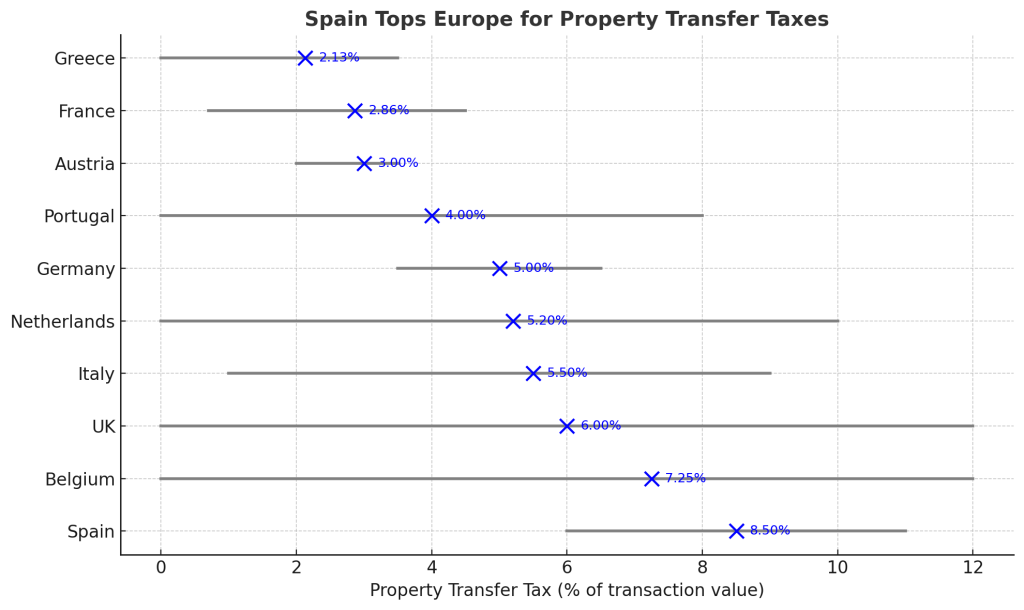
At one extreme, buyers in parts of Spain face the highest transfer taxes anywhere in the European Union.
READ MORE: Moving to Andalucia: The best suburban areas of Sevilla
At the other, in Zurich, home to some of the priciest property in the world, buyers pay nothing at all thanks to a 2005 law abolishing transfer tax to encourage real estate deals.
A new analysis by the Financial Times shows just how punishing Spain’s regime can be.

On a €300,000 property, the transfer tax bill can exceed €30,000 in the Valencia region or Catalonia. Both regions levy a flat 10% rate, the steepest in Europe.
Demand from tourists and second-home owners on the Mediterranean coast has fuelled political pressure to maintain such rates, even as local buyers struggle with affordability.
By contrast, Belgium – long known for expensive taxes – applies a 12% registration levy, though regional governments in Flanders and Brussels have softened the blow for first-time buyers with discounts and exemptions.
France’s transfer tax is lower at around 5%, though agency fees of up to 8% of the property’s value add a hidden sting.
Andalucia: Lower rates but not exempt from pressure
In Andalucia, which includes the tourism meccas of Sevilla, Malaga and the Costa del Sol, the regional government has tried to pitch itself as more competitive.
In 2021 it cut the transfer tax to a flat 7% – a significant reduction compared with Catalonia and Valencia.
This means that a €300,000 property incurs a tax bill of €21,000 in Andalucia, versus €30,000 in the Mediterranean’s two most expensive regions.
Additionally, first-time buyers under 35 will pay just 3.5%, as long as the property is valued at a maximum of €150,000.
The government also lowered stamp duty on mortgages from 1.5% to 1.2%, arguing that the changes would stimulate investment and encourage buyers to choose Andalucia over other parts of Spain.
These cuts were politically framed as a way to attract both national and international purchasers, especially in Málaga and Marbella, where foreign demand is strongest.
But while Andalucia’s tax rates are lower, affordability pressures remain severe. House prices in Malaga province rose more than 10% year-on-year in 2024, driven in large part by foreign buyers.
Critics argue that reducing taxes has done little to ease the strain on local families trying to buy their first home, while significantly reducing regional revenues.
Taxes vary across Spain
In Spain, property taxation is fragmented, with rates set by the 17 autonomous regions rather than central government.
Catalonia has introduced targeted relief – a reduced 5% rate for buyers under 35 – but at the same time raised marginal rates on high-end purchases to 13% for amounts above €1.5 million.
Valencia still offers support for young and lower-income families, but scrapped discounts for wealthier buyers. The region raised €1.5 billion in transfer taxes in 2024 alone, accounting for 60% of all devolved tax income.
The disparities across Europe are stark. In England and Northern Ireland, stamp duty applies progressively, with a 5% surcharge for second homes.
First-time buyers, however, are exempt on purchases up to £300,000. In Italy and Germany, agency fees hover at about 3%, while in Spain they are negligible compared to the heavy transfer taxes.
With Spain topping the EU league table for home-buying taxes, pressure is growing on regional leaders to ease the burden on first-time buyers.
Yet with tourism and overseas demand continuing to inflate property prices, the political will to cut these lucrative taxes remains limited.
Read more Spanish property news at the Spanish Eye.