Plans for a railway tunnel connecting Spain and Morocco have received fresh momentum after Madrid approved new funding to continue technical studies for the project.
The Spanish government has authorised a transfer of €1.73 million for 2026 to support ongoing research into the historic proposal, which aims to create a permanent rail link between Europe and Africa.
The funding will allow the state-owned company responsible for the project, the Spanish Society for Fixed Communication Across the Strait of Gibraltar (Secegsa), to continue its work.
Secegsa operates under the Ministry of Transport and Sustainable Mobility, led by Oscar Puente, and is chaired by General Jose Luis Goberna Caride.
The latest funding injection forms part of a financing programme launched in 2022 by the government of Prime Minister Pedro Sanchez to revive the long-discussed project.
Since then, more than €9.6 million has been allocated to the company, a sharp increase compared with the roughly €50,000 per year it received before relations between Spain and Morocco were strengthened.
A strategic link between continents
The idea of a fixed link beneath the Strait of Gibraltar has been debated for decades and is considered one of the most ambitious transcontinental engineering projects ever proposed.
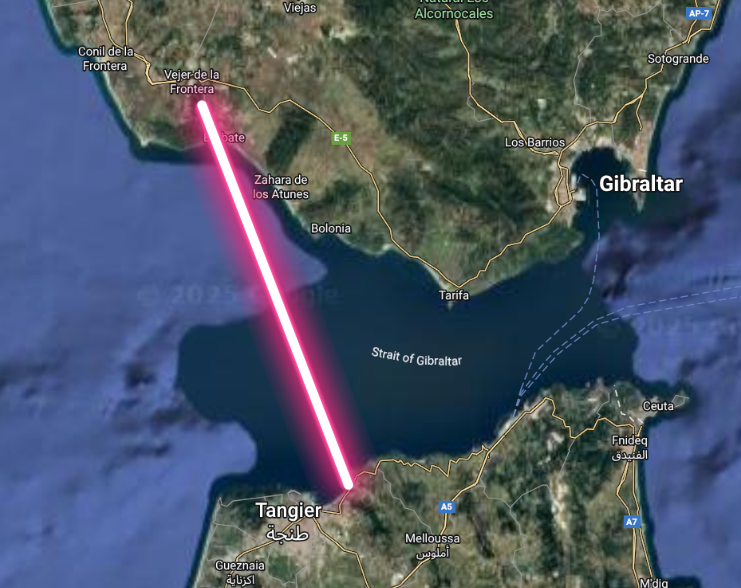
Current plans envision a railway tunnel of around 65km in length linking southern Spain with northern Morocco. The design includes two rail tunnels for passenger and freight trains as well as a service tunnel.
At its deepest point, the tunnel could reach around 475 metres below the seabed. The journey between the two continents, which are separated by roughly 14km at their closest point, could take around 30 minutes by train.
The Spanish terminal is expected to be located near Vejer de la Frontera in Cadiz province, where it would connect to the Cadiz-Sevilla railway line and potentially a branch line towards Algeciras.
New studies planned for 2026
Alongside the new funding, the government has tasked the public engineering firm Ineco with updating the full preliminary project for the link.
This technical document, expected to be completed during 2026, will define the final route, geological analysis, safety systems and the design of the associated infrastructure.
One of the key elements under consideration is the construction of a reconnaissance tunnel, an experimental passage that would allow engineers to study the geological conditions beneath the Strait before beginning full excavation.

If plans move forward, the basic project for this exploratory tunnel could be put out to tender from 2027.
Major geological challenges
The geology of the Strait of Gibraltar is one of the biggest obstacles facing the project. The area contains active fault lines, deep sediments and occasional seismic activity, meaning extensive geological surveys are required before construction could begin.
In recent months, Spain and Morocco have intensified their scientific cooperation and exchanges of geological data as part of the renewed push to advance the project.
A multibillion-euro project
Current estimates suggest the construction phase alone could take around 10 years and cost more than €8.5 billion on the Spanish side, although the final figure will depend on the results of ongoing geological studies.
A report from German tunnelling specialist Herrenknecht has concluded that the project is technically feasible with existing technology. However, engineers warn that the route would be extremely complex, particularly in the Camarinal Sill area, considered the most challenging section of the crossing.
The renewed funding has also attracted attention in Morocco, where media outlets have highlighted Spain’s renewed commitment to the project as part of a broader revival of cooperation between the two countries.
Read more Andalucia news at the Spanish Eye.