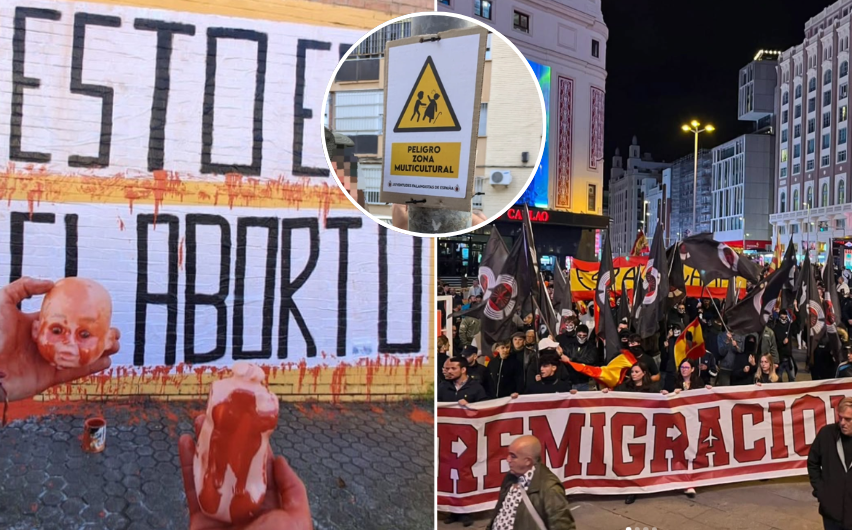

Spain’s Falange Youth (Juventudes Falangistas de España) gained international headlines this week after their racist signs went viral.
- Who are the Falangists?
- ‘No to being the bar of Europe’
- 1. Abolition of Spain’s autonomous communities
- 2. Strict border control
- 3. ‘More sovereignty, less globalism’
- 4. Change of productive model
- 5. No further cuts to essential services
- 6. ‘Dignity for the Spanish worker’
- 7. An economy ‘at the service of Spaniards’
- 8. Fewer politicians, ‘more Spain’
- Are Falangists a real threat and why aren’t they banned?
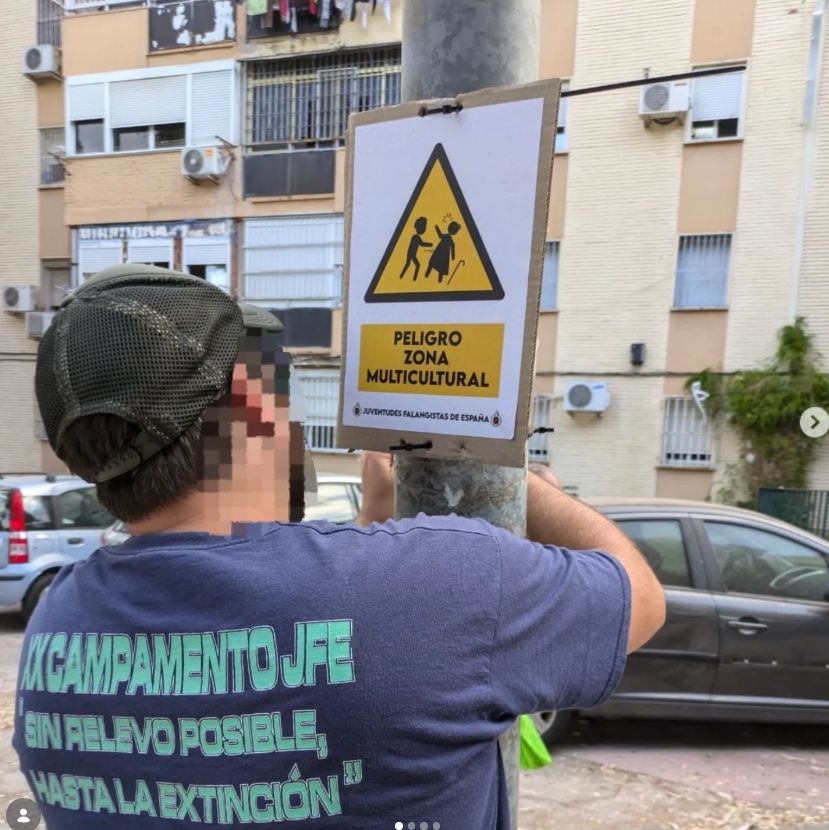
The cardboard ‘warnings’ were tied to lampposts outside a hotel in Tenerife that is being used to house undocumented migrants.
The sign reads: ‘Danger, multicultural zone’, and shows an image depicting a man attacking an elderley woman with a walking stick.
The stunt was widely condemned as racist for depicting young migrants as violent and dangerous criminals, in what has become a growing stereotype in Spain.
But it’s not the first time the fascist group has erected offensive messages.
The same sign was seen posted on lampposts in the Malaga neighbourhood of Palma Palmilla last year.
A quick look on the group’s Instagram account also reveals their extreme views.
In recent months, they have been highly operational in Andalucia, with two abortion clinics targeted in Cordoba and Sevilla, and anti-Islam messages issued in Algeciras.
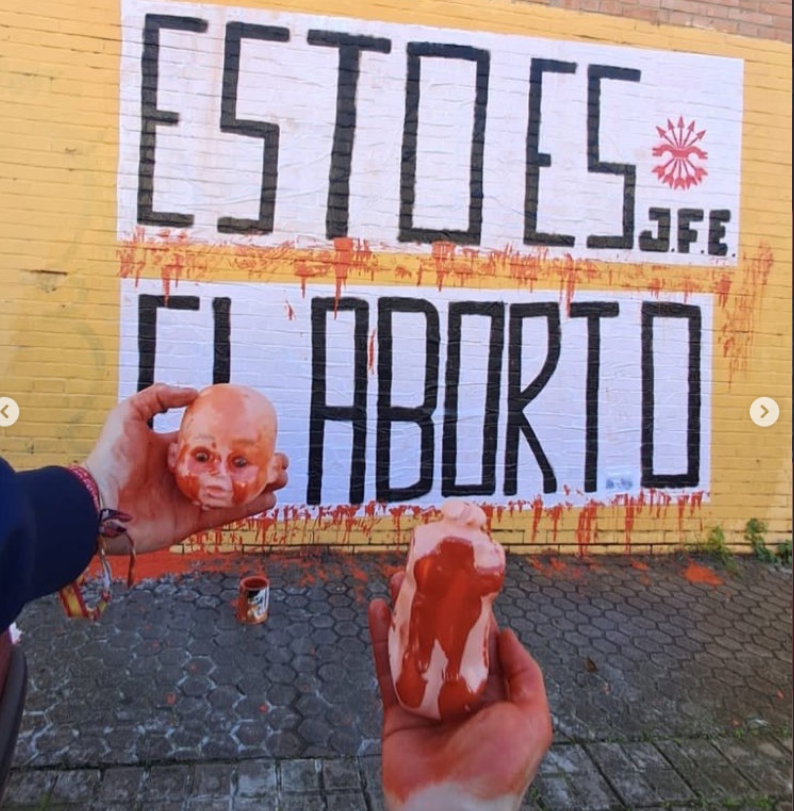
Pictures uploaded show a baby doll cut into pieces and covered in fake blood left outside one of the centres.
A graffitti message behind it reads: ‘This is abortion.’ Signs tied to lampposts outside both read: ‘Danger of death, children are killed here every day.’
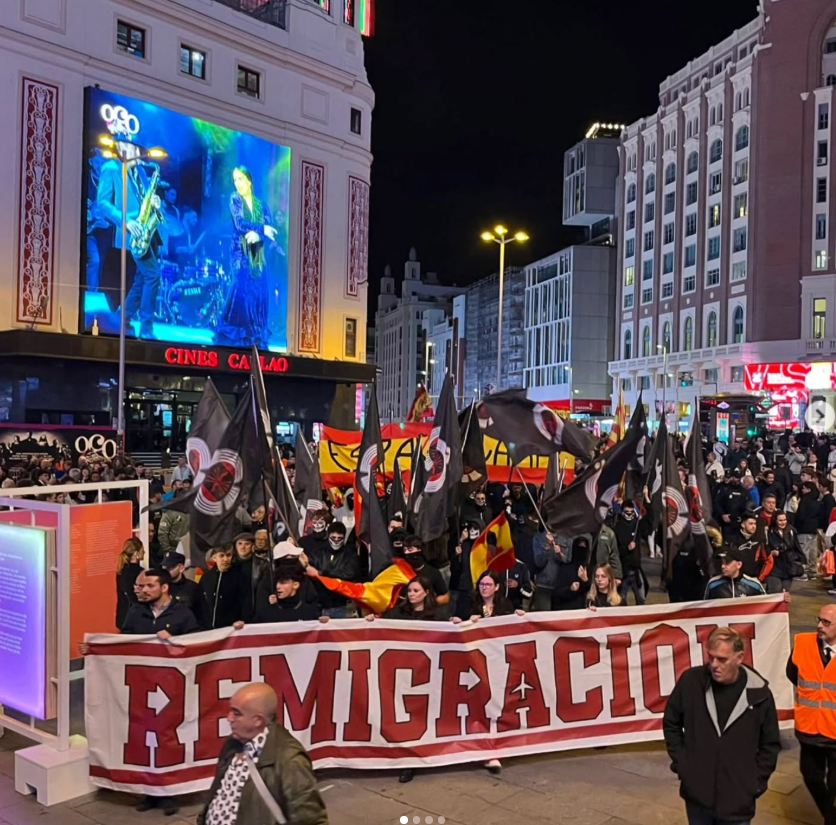
Like other extremist groups in Spain, the young falangists are proponents of the mass ‘remigration’ cause – which essentially involves the expulsion of all immigrants from Spain (in particular from Muslim countries).
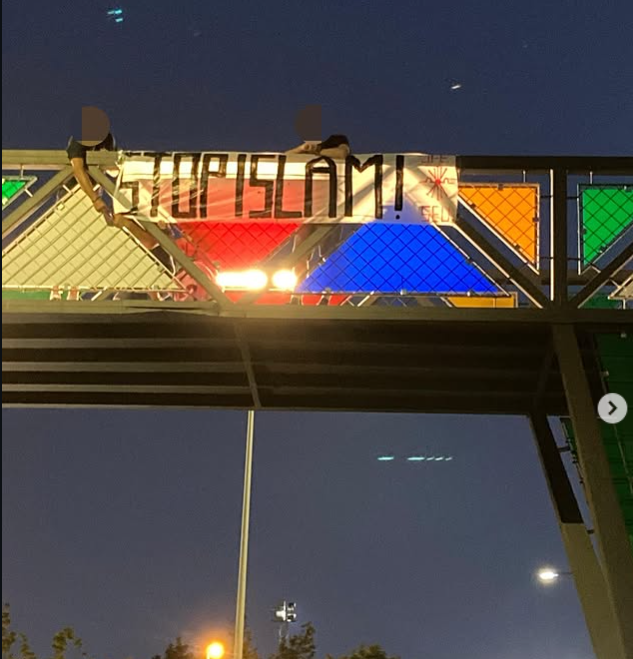
Indeed, Islam is deemed an enemy by the group, with many banners unfurled during its protests seen warning of the ‘Islamification of Europe’, while another simply reads: ‘Stop Islam!’
The Young Falangists of Spain have gained thousands of new followers on their Instagram page in recent weeks, which now counts more than 16,000 – while their Telegram channel has around 1,800 subscribers.
Who are the Falangists?
Falangists were members of the Falange Española, a Spanish fascist party founded in 1933 by Jose Antonio Primo de Rivera, which later merged with Carlists to become the sole legal party under Francisco Franco’s dictatorship.
They were characterised by extreme nationalism, authoritarianism, and ‘blue-shirt’ paramilitarism, actively supporting the Nationalist cause during the Spanish Civil War and structuring the state’s vertical unions.
While they officially disbanded as a political party in 1977, their supporters remained in small pockets across the country.
In recent years, there has been a resurgence in Francoist revisionism, particularly among some young people, who believe ‘life was better’ under the dictator.
Today, according to its website, the Youth of the Falange is attracting youngsters fed up with the ‘capitalist system’ and the ‘political class’.
‘We are young people who have grown up in a society tormented by unemployment, hunger, terrorism… injustices caused by a system – capitalism – and its government – the political class,’ it reads.
The group says it is ‘at war’ with the system and is taking a three-pronged approach to fight it: political, social and educational.
Its actions, it says, involve demonstrations and protests, lectures and readings and organising charity and culture events.
It also encourages its members, who appear to be mostly young men, to play football and go on camping trips.
Photos shared via Instagram show dozens of its members attending a boxing class.
‘No to being the bar of Europe’
In a manifesto posted in 2020, the group said it wants to ‘restart Spain’, listing eight key plans.
The document, titled #ReiniciemosEspaña (‘Let’s Restart Spain’), presents what it describes as ‘effective measures of immediate application’ to address both the general crisis and the fallout from Covid-19.
It outlines eight main priorities:
1. Abolition of Spain’s autonomous communities
The manifesto calls for the dissolution of Spain’s regional autonomous governments and the closure of their institutions. It proposes returning competencies to the central state, centralising what it considers ‘essential’ matters, while giving greater proximity-based powers to provinces and municipalities.
2. Strict border control
It advocates suspending the Schengen system and expelling irregular migrants, as well as legal migrants who are unemployed and/or have criminal records. It also proposes tighter visa requirements for entry into Spain.
3. ‘More sovereignty, less globalism’
The document calls for what it describes as ‘real independence,’ including withdrawal from supranational organisations that it claims undermine Spanish sovereignty – explicitly naming the EU, the euro, NATO and the IMF. It promotes forming relationships with other nations ‘on equal terms’ based on shared interests and values.
4. Change of productive model
It proposes national reindustrialisation and increased support and resources for the primary sector. The text rejects the idea of Spain being ‘the bar of Europe,’ favouring instead cultural and family-oriented tourism over mass tourism.
5. No further cuts to essential services
The manifesto calls for what it terms fair funding of public services such as healthcare, education and social services, which it describes as free and high quality. It also supports investment in science and R&D, and domestic production of materials needed for essential services.
6. ‘Dignity for the Spanish worker’
It proposes repealing labour market reforms, legislating in favour of workers, removing obstacles for the self-employed and encouraging the creation of cooperatives.
7. An economy ‘at the service of Spaniards’
The platform calls for the nationalisation of banks, credit and companies in strategic sectors. It also proposes price regulation for essential goods and services, tax reductions for SMEs, housing support for families and policies aimed at increasing the birth rate.
8. Fewer politicians, ‘more Spain’
The manifesto proposes eliminating public subsidies to political, trade union and business organisations, reducing the number of public offices and political appointees, streamlining public administration and exercising tighter control over public spending.

Are Falangists a real threat and why aren’t they banned?
Falangist parties, such as Falange Española de las JONS, are not banned in Spain primarily because the Spanish Constitution protects freedom of expression and political association, making the prohibition of political ideologies difficult.
Despite their historical ties to the Franco dictatorship, they operate legally as minor extremist groups, although they can face fines for glorifying the regime.
Instead of outright bans, the Spanish government has used the Democratic Memory Law to penalise public acts that glorify the dictatorship or honour fascist leaders, with Falange groups facing fines for such activities.
Despite their extreme and worrying views, Falangist groups remain largely marginal and electorally insignificant in modern Spain, making them a low threat to the democratic order compared to other, newer right-wing populist movements.
Read more Andalucia news at the Spanish Eye.