
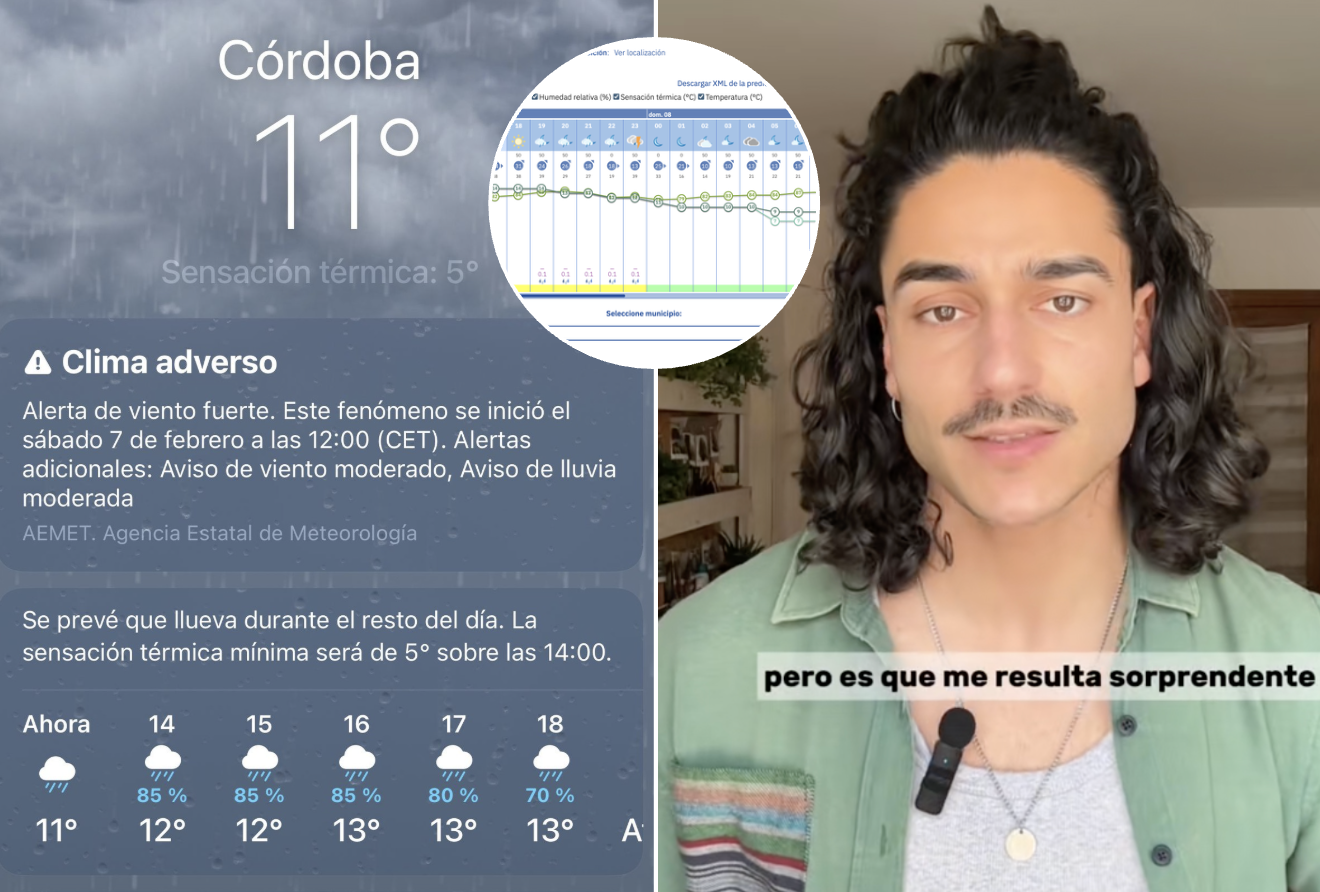

Checking the weather forecast on a mobile phone app has become routine, especially during periods of heavy rain – but what do those percentages actually mean?
Geography and history teacher Santi Sabariego last year shared a video on his TikTok account explaining how to interpret them.
What the % do NOT mean
‘I’m always surprised by how many people get these percentages wrong,’ he says in the video.
‘So much so that if not a single drop of rain falls over 10 days, most people get angry and say the weather forecasters always get it wrong, when in reality the forecasts may have been accurate.’
Sabariego begins by explaining what the figures do not mean. A 70% chance of rain does not mean that 70% of meteorologists think it will rain.
It does not mean it will rain over 70% of the city, nor that it will rain for 70% of the day.
He then outlines how forecasts are actually produced.
How the forecasts are made
Meteorologists use what is known as ensemble forecasting, a complex method based on interpreting large amounts of data.
First, they analyse the current state of the atmosphere using information from radar, satellites and weather stations, which produces an initial forecast.
From there, scientists generate around 50 slightly altered scenarios using statistical calculations. This results in 51 different forecasts for the same place and time.
‘If it rains in 30 of those 51 scenarios, the probability of rain is 60%,’ Sabariego explains. ‘If it rains in all of them, then the probability is 100%.’
So, a 95 per cent chance of rain means that 95 out of every 100 model runs predicted rainfall, not that rain is guaranteed.
He also points out that hourly forecasts often show lower probabilities than daily ones.
‘It might not be very likely to rain in any single hour,’ he says, ‘but if many hours throughout the day have a chance of rain, it’s quite likely it will rain at some point.’
Finally, Sabariego stresses that even if it does not rain, that does not mean the forecast was wrong. Weather forecasting is probabilistic, not exact.
‘Meteorology isn’t a perfect science,’ he concludes.
Where is best to check for rain?
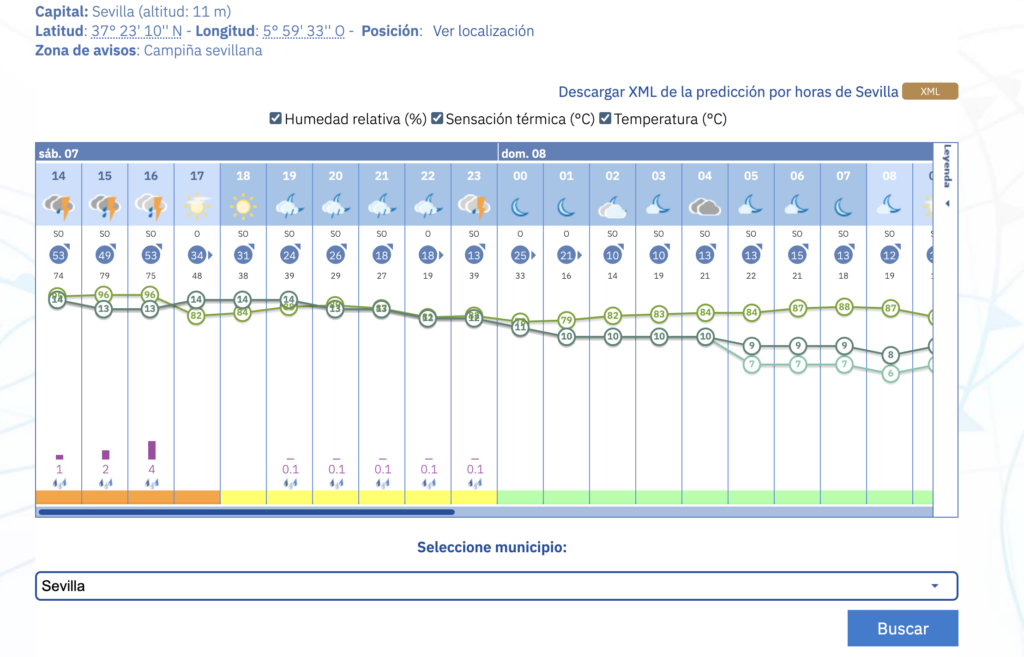
State weather agency Aemet has a much more useful tool for checking for rainfall by the hour.
It covers any town or city across Spain and gives you the predicted mm of rain per hour of the day.
This link here, for example, shows the rainfall predicted in Sevilla by the hour. You can change the municipality to look in your own area.
Read more Andalucia news at the Spanish Eye.