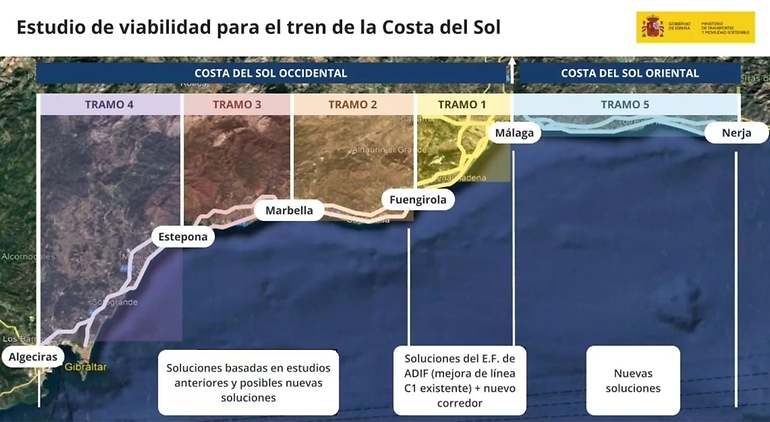
Extending Malaga’s train network from Fuengirola to Marbella has ‘clear potential’, the government has said.
Speaking at a New Year briefing in Malaga, the government’s representative in the province, Javier Salas, confirmed that a long-awaited feasibility study commissioned by the Ministry of Transport last May will be made public after the summer.
While the final conclusions are still pending, Salas said the data gathered so far points to ‘a certain degree of viability’ on what he described as one of the priority sections of the proposed coastal railway.
According to Diario Sur, Salas said mobility figures show that the Fuengirola–Marbella corridor concentrates the highest daily movement of people anywhere along the coast, strengthening the case for rail investment.
Different route options are being analysed, including a possible alignment running alongside the A-7 motorway, although he stressed that no final decision will be taken until the study is complete.
In November, the Ministry of Transport openly described the extension of the railway as both ‘possible’ and a project it hoped to carry out.
According to sources cited by respected local newspaper Malaga Hoy, one of the preferred options on the table was a major tunnel running beneath the A-7.
Because the coastline is so densely built-up, and because no land was ever reserved for a future railway, the main viable solution is underground, it was reported.
The works would be carried out in short sections to limit disruption on the A-7, with only one lane expected to be closed at a time.
The alignment most likely to move forward would begin from the tunnel already in place at the Fuengirola end of the Cercanías C-1 line.
Continuing the existing commuter rail service to Marbella is therefore gaining weight as the preferred outcome.
This approach was also advocated by Álvaro Fernández Heredia (now president of Renfe) when he was still a senior official within the ministry.
Experts consulted by local media estimate that each construction section would cover around 15–20km and could take roughly two years.
At the same time, land expropriations would need to begin, in a process that, even in the fastest scenarios, could require six months to tender and another six to complete.
Even under favourable conditions, specialists believe the total construction period would not fall below four years, and the works could stretch significantly longer depending on funding, planning setbacks or political change.
Although works could theoretically be carried out simultaneously along different sections, engineers warn that digging up the entire coastline at once would be unfeasible for residents, tourism and logistics.
A separate study prepared by engineer José Alba for Unicaja Banco estimated the Malaga–Marbella connection could be completed within eight years, at a cost of between €2.5 and €2.8 billion depending on the final design.
Read more Costa del Sol news at the Spanish Eye.