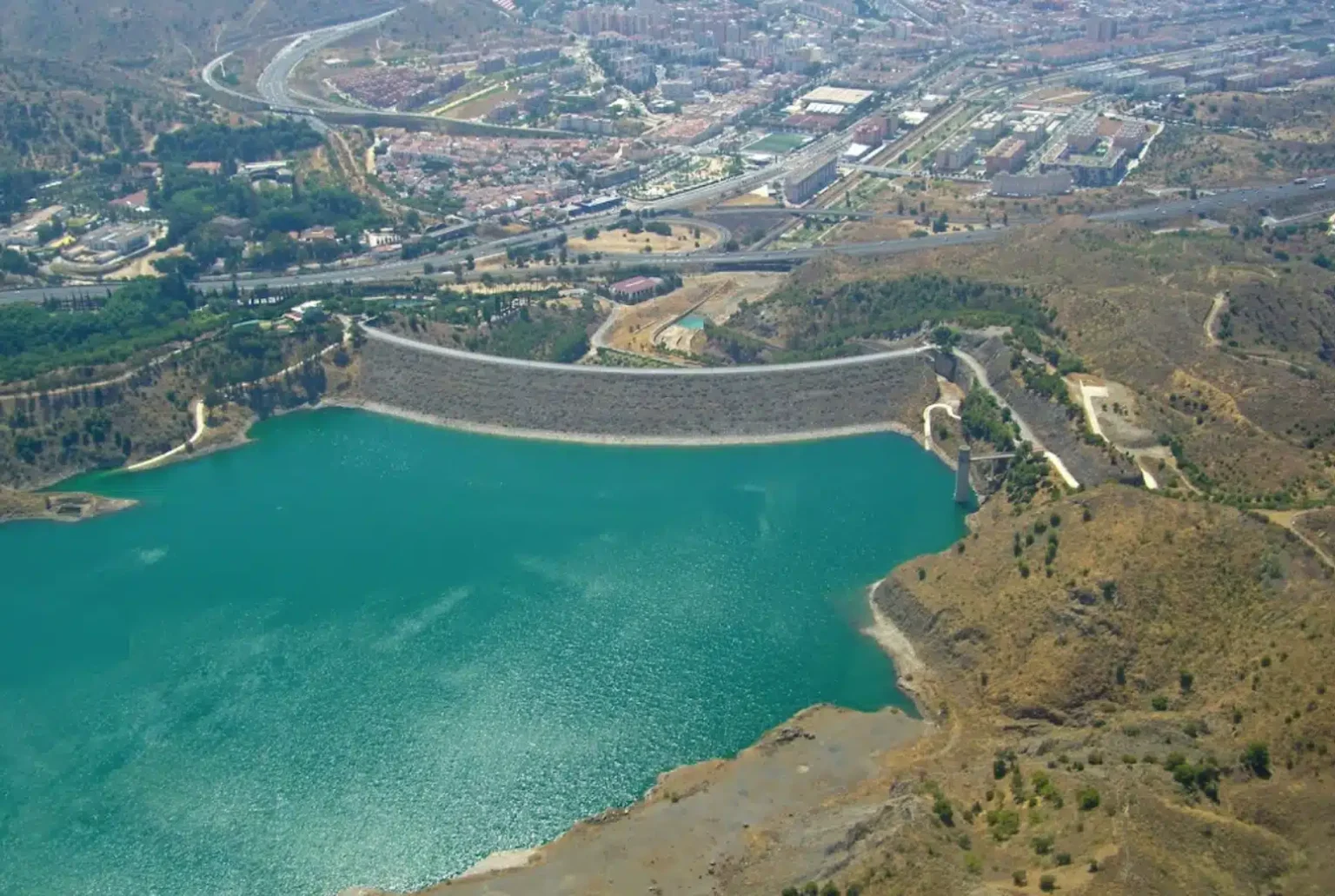

Water supplies are guaranteed across Malaga province this year following a series of severe storms that have seen more than 30 hectometres cubed of rainwater collected in just one week.
According to reports, the province has around three years of guaranteed water thanks to reserves stored across seven reservoirs, dozens of emergency wells, and output from the Marbella desalination plant.
So far this year, rainfall across Malaga’s reservoir network averages 1,324 litres per square metre.
Taking into account runoff and existing reserves, the province’s dams are now 57% full, holding 343.9 hectometres cubed (hm³) of water.
Put simply, that volume alone would cover two years of consumption for Malaga city, the Costa del Sol and La Axarquia combined, if water could be freely moved around the system.
Factoring in desalination and current consumption patterns, officials are confident supplies are secure until at least late 2028.
The main limitation is infrastructure. The pipeline linking Malaga city with the western Costa del Sol remains out of service after being damaged by a DANA storm near Benalmadena.
Even before the break, it was operating below capacity. The Junta de Andalucía and Acosol have begun repair work on several sections.
The western Costa del Sol remains Malaga’s largest water user, with annual demand of around 90 hm3 – nearly double that of Malaga city, despite a similar population size.
Once the ongoing expansion is complete, the existing desalination plant will be able to produce up to 20 hm3 annually.
Plans are also progressing for a second desalination plant in Mijas, which would double that capacity and reduce pressure on aquifers.
Higher coastal demand is driven by golf courses, villa irrigation and a seasonal population that can surge to one million in summer, making water reuse and regeneration increasingly critical.
The districts of Ronda and Antequera, meanwhile, operate outside the main provincial system, relying on springs and wells.
In Antequera, mayor Manuel Baron said last year the city had around three years of water available, thanks to renewed flow at the El Torcal spring. The city also supplies Valle de Abdalajís after rail works damaged local wells.
Ronda, supplied by wells in the Cañada de Puya, consumes just 2.85 hm3 a year and has largely avoided drought risk in recent years due to its location in one of southern Spain’s wettest valleys.
Read more Andalucia news at the Spanish Eye.