
Spain’s new V16 emergency warning lights are continuing to come under scrutiny just days before they become mandatory for most drivers nationwide.
Now, a frontline firefighter has added fuel to the debate over whether they are safe enough in real-world conditions.
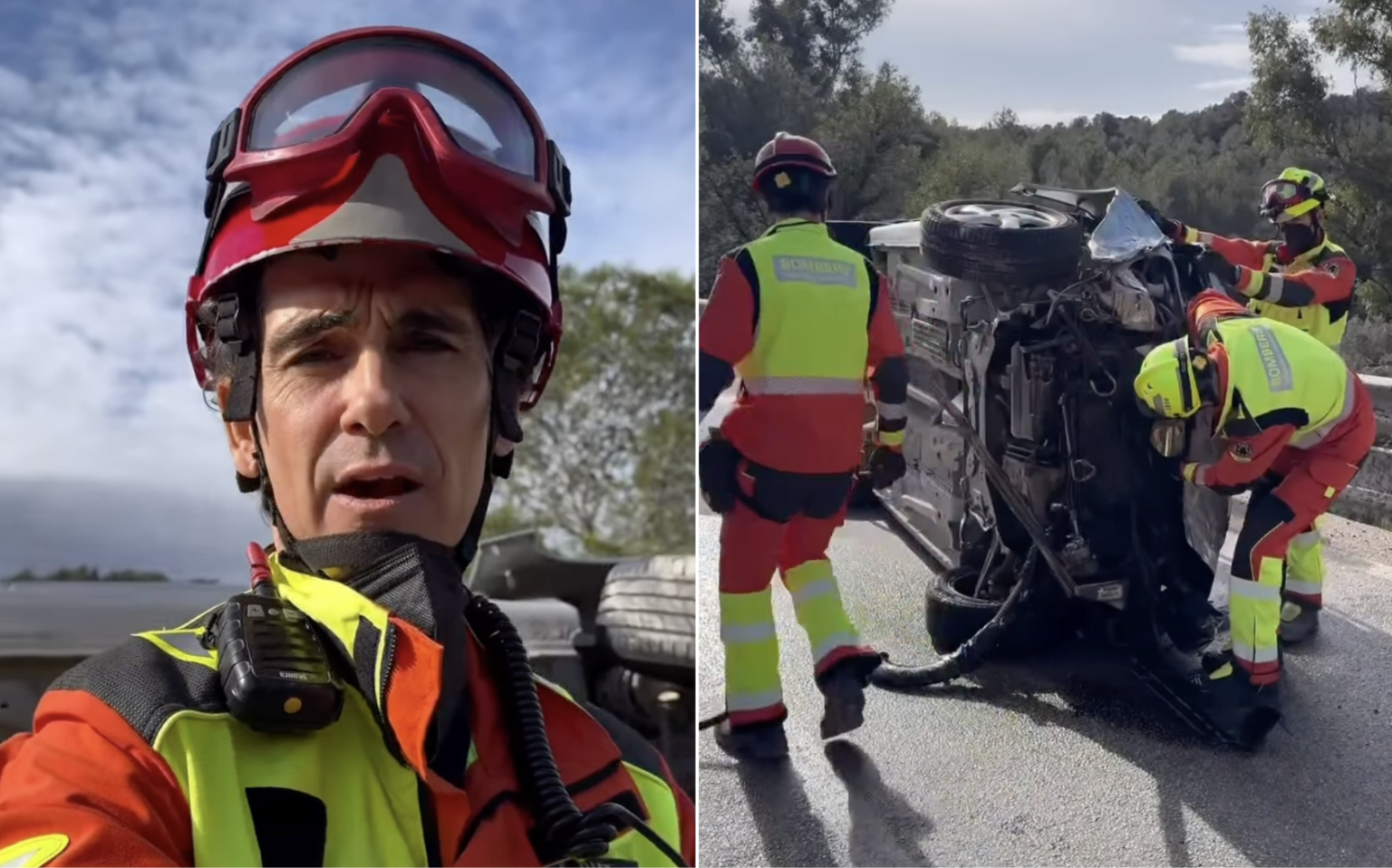
Edi Diaz, a firefighter with extensive experience attending roadside accidents, has gone viral after posting a video filmed at the scene of a real crash.
In it, he questions whether V16 lights provide sufficient warning to oncoming traffic in dangerous locations such as sharp bends, crests and low-visibility stretches of road.
Holding a V16 beacon beside a car stopped on a tight curve, Diaz asks where it can realistically be placed so that approaching drivers see it in time.
Current regulations require the light to be positioned on the roof of the vehicle – but Diaz argues that this may not give motorists enough advance notice to slow down safely.
Based on his experience, the firefighter delivers a blunt message to drivers who have already abandoned triangles entirely.
‘As a professional recommendation, don’t stop carrying warning triangles in your car,’ he says in the video.
His concern centres on anticipation, a key principle of road safety.
Traditional triangles are placed 50 metres before a stationary vehicle, giving drivers time to react and reducing the risk of secondary collisions – one of the most dangerous scenarios for emergency services.
By contrast, the V16 light remains attached to the vehicle itself.
‘On a crest, in poor light, or on a bend, this won’t be seen,’ Diaz warns. ‘Either we signal properly 50 metres before the car, or we’re going to have a problem.’
He adds that rescue teams see the consequences first-hand: ‘Believe me, as firefighters, we don’t want to be pulling people out of trapped vehicles.’
Diaz does not dismiss V16 technology outright. He acknowledges that the lights have clear advantages, particularly because drivers no longer need to step out of their vehicle on fast roads.
But his message is that V16 lights should be a complement, not a substitute.
‘They’re fine as an additional signal,’ he says. ‘But additional, don’t ever stop carrying triangles.’