
By using this site, you agree to the Privacy Policy.
Accept
Sign In
The Spanish EyeThe Spanish EyeThe Spanish Eye
Notification Show More
  • Home
  • News
  • Travel
  • Events
  • Health
  • Property
  • About Us
  • Contact
  • Login
  • Subscribe
Reading: ‘Cannibal’ solar storm reaches Earth overnight – here’s how it will affect Spain
Share
The Spanish EyeThe Spanish Eye
Search
  • Home
  • News
  • Travel
  • Health
  • Property
  • About Us
  • Contact
  • Subscribe
Have an existing account? Sign In
Follow US
The Spanish Eye > National news > ‘Cannibal’ solar storm reaches Earth overnight – here’s how it will affect Spain
National newsNews

‘Cannibal’ solar storm reaches Earth overnight – here’s how it will affect Spain

Last updated: November 12, 2025 10:13 pm
Laurence Dollimore
Published: November 12, 2025
Share
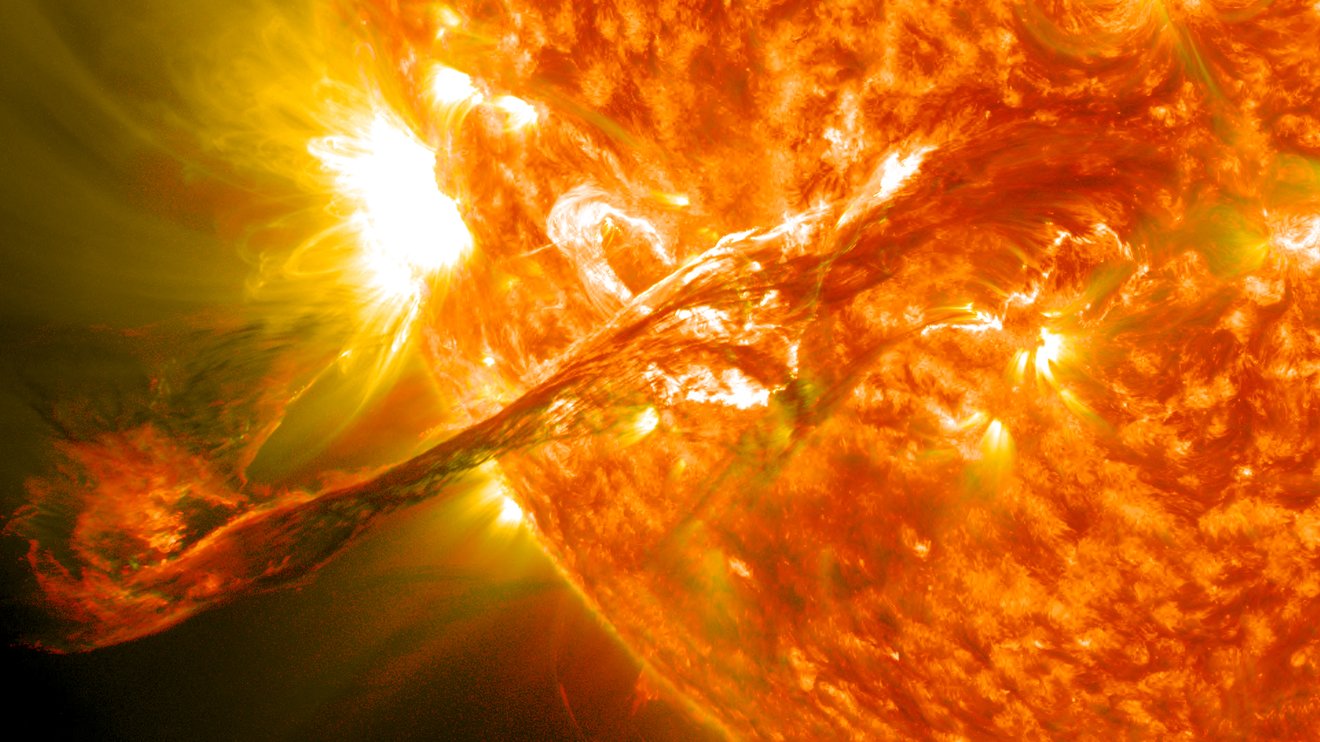
This coronal mass ejection, captured by NASA’s Solar Dynamics Observatory, erupted on the Sun Aug. 31, 2012, traveling over 900 miles per second and sending radiation deep into space.. Credit: NASA/GFSC/SDO

A powerful solar storm is being felt on Earth tonight following a powerful eruption on the sun that could affect satellites, GPS systems and more.

At around noon Spanish time on Tuesday, scientists detected a coronal mass ejection (CME) travelling at an estimated 1,500 kilometres per second.

It means a burst of solar material is now expected to reach Earth between Wednesday afternoon and Thursday morning.

Watch: Northern lights visible from Spain’s Andalucia due to ‘severe’ solar storm

Experts have warned that the resulting geomagnetic storm could be ‘severe’, potentially affecting satellites, power grids and navigation systems. However, they stress that there is no direct biological risk to the population.

The European Space Agency (ESA) is closely monitoring the event through its network of space weather centres, gathering detailed data on what is being described as one of the most significant solar events in recent years.

Meanwhile, the British Geological Survey (BGS) upgraded its forecast to the maximum and said the storm could feed off another one creating one of the biggest ‘cannibal storms’ in 20 years.

In parts of Catalonia and Andalucia, the phenomenon has already produced a rare sight, with the aurora borealis visible from several locations.

Spain’s own Space Agency (AEE), working in coordination with its European counterpart, is tracking the storm to anticipate any potentially critical developments.

According to the Ministry of Science, Innovation and Universities, the effects over Spain ‘are expected to be limited and short-lived’. The ministry added that there would be no serious consequences for the public or for the operation of national technological systems.

Officials emphasised that Spain’s mid-latitude position, far from polar regions, greatly reduces the strength of any geomagnetic disturbances. As a result, no major damage or interruptions are anticipated to critical infrastructure such as energy networks or communication systems.

In practical terms, there may be minor interference in satellite navigation services, including small losses of accuracy in GPS and GNSS applications. Shortwave or high-frequency radio communications could also experience brief disruptions, though mobile networks, internet, and FM radio should remain unaffected.

Spanish-operated satellites, including those used for telecommunications, weather observation, and Earth monitoring, are not expected to suffer significant impacts. In some cases, automatic safety protocols may activate or brief data errors could occur, but without any lasting service interruption, the ministry confirmed.
- Advertisement -
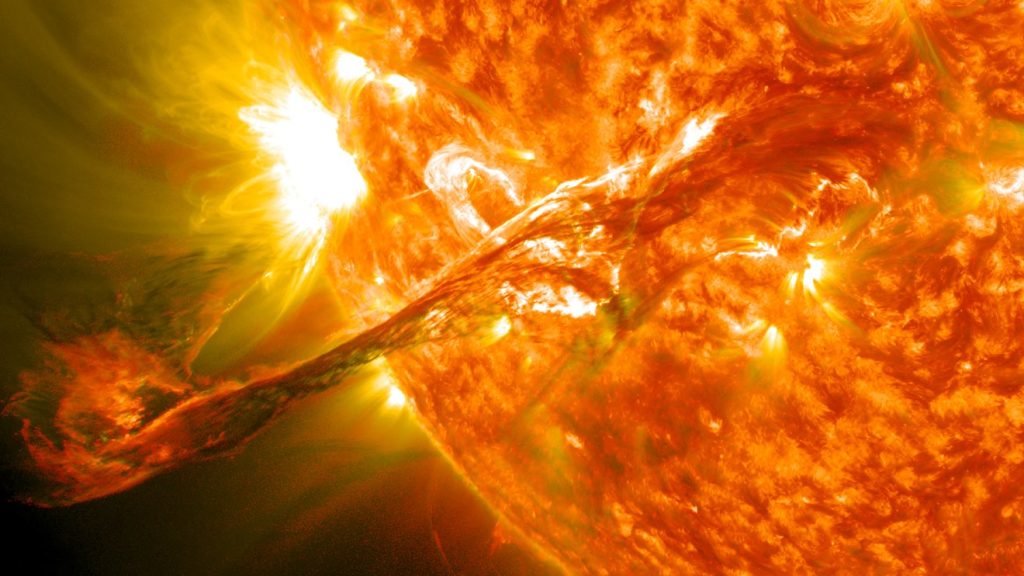
A coronal mass ejection, captured by NASA’s Solar Dynamics Observatory on August 31, 2012, (Credit: NASA/GFSC/SDO)

‘Despite this being the most intense solar storm in recent years, and while continued vigilance is essential, all indications suggest the effects over Spain will be limited and short in duration, with no serious impact on people or key technologies,’ the ministry said.

Meanwhile, both the European Space Agency and the US National Oceanic and Atmospheric Administration (NOAA) are maintaining active surveillance of the solar storm.

The NOAA reported that the core of the storm is currently passing over Earth and may continue for several more hours, also responsible for the spectacular auroras seen across parts of Europe.

Geomagnetic storms are ranked from G1 (minor) to G5 (extreme). Earlier this week, the NOAA raised its alert to G4 (severe) as the ejected solar particles struck Earth’s magnetic field. The current level has eased slightly to G3 (strong), though the agency warns that conditions could still intensify again, with elevated activity likely to persist until Friday.
WATCH: Swedish expat blasted by local mayor for jumping into Cadiz floods ‘to save his dogs’
PICTURED: Tragic yoga teacher Carol, 45, swept away by Malaga flood while rescuing her dog
Tornado alerts in Andalucia as Storm Marta rolls in: Warning also elevated for Costa del Sol
‘Difficult days are coming’: Spain’s Pedro Sanchez visits site of ‘climate crisis’ in Cadiz
WATCH: Hundreds forced to evacuate Malaga’s Benaojan over fears an inactive dam will fail
TAGGED:solar stormSpain

Sign Up For Newsletters

Be kept up to date! Get the latest breaking news delivered straight to your inbox.
Please wait...

Thank you for signing up!

Share This Article
Facebook Email Print
ByLaurence Dollimore
Laurence Dollimore has been covering news in Spain for almost a decade. The London-born expat is NCTJ-trained and has a Gold Star Diploma in Multimedia Journalism from the prestigious News Associates. Laurence has reported from Spain for some of the UK's biggest titles, including MailOnline, The Telegraph, Daily Mail, Mail on Sunday, The Sun and the Sun Online. He also has a Master's Degree in International Relations from Queen Mary University London.
Leave a Comment

Leave a Reply Cancel reply

You must be logged in to post a comment.

Popular News
NewsWeather

Powerful storm to hit Andalucia on Sunday ahead of a WEEK of rain across the region

Laurence Dollimore
January 31, 2026
‘Fed up’ Brits slam southern Spain’s ‘worst winter in decades’ – ahead of fresh storms
Explained: How Carlos Alcaraz will lose almost half his Australian Open winnings to Spain’s taxman – and where it will go
Explained: The dangerous ‘flying river’ set to drop a water bomb on Spain’s Andalucia
Tornado warnings issued for Andalucia: These areas are under alert on Monday

Events

07
Feb
07
Feb

I Congreso Internacional con los mejores expertos en Altas Capacidades

2026-02-07 @ 08:00 AM
5 Avenida de Medina Azahara, 14071 Córdoba, Spain
Load more listings
Add an Event

You Might Also Like

CordobaNewsWeather

WATCH: Cordoba prepares for ‘worst possible scenario’ as Storm Marta to push Guadalquivir River to its limit – iconic bridge is sealed off

February 6, 2026
NewsPremiumProperty

How long does it take to buy a home in Spain? Property expert MATHEW WOOD explains all

February 6, 2026
National newsPolitics

WATCH: Spain’s Pedro Sanchez defends regularisation of 500,000 migrants in CNN interview

February 6, 2026
MalagaNewsWeather

WATCH: Ground visibly collapsing behind homes in flood-hit Malaga after army evacuates residents

February 6, 2026

Categories

  • News
  • Costa del Sol
  • Weather
  • Travel
  • Andalucia
  • Crime
  • Costa del Crime
  • Property
  • Health
  • Life in Spain

The Spanish Eye

Your first look at what’s happening in Andalucia Spain - All the latest news, opinion and analysis.
Quick Link
  • Home
  • News
  • Subscribe
  • Contact
Top Categories
  • News
  • Travel
  • Health
  • Property

Get News straight to your inbox

Subscribe to our newsletter to get our newest articles instantly!

Please wait…

Thank you for signing up!

© The Spanish Eye 2024 - All rights reserved | Privacy Policy
Welcome Back!

Sign in to your account

Username or Email Address
Password

Lost your password?

Not a member? Sign Up