

Spain’s property market is still delivering for investors, especially those looking beyond the usual hotspots.
While national rental yields average 6%, some city neighbourhoods are outperforming by a wide margin, offering returns of up to 10.9%.
The key, according to experts, is affordable purchase prices and high rental demand.
According to the 2025 report by property portal Fotocasa, the most attractive areas for buy-to-let investors are often found on the outskirts of major cities or in mid-sized markets with room for growth.
Madrid leads, but not in the city centre
Top of the list is Villaverde Alto, a working-class neighbourhood in southern Madrid, where yields have reached 10.9%, the highest in the country.
Other Madrid districts like Numancia, Lucero, and San Diego also make the top 10, each with yields around 8% or more.
These areas may not have the prestige of central Madrid, but for landlords focused on returns, they’re outperforming high-end zones by far.
Andalucia offers strong returns too
Andalucia isn’t far behind. In Sevilla, the district of El Torrejon – El Cerezo offers a healthy 8.9% return, making it the second most profitable neighbourhood in Spain right now.
This supports a wider trend highlighted by María Matos, Director of Research at Fotocasa: ‘The highest profitability is still found in areas with more affordable prices.’
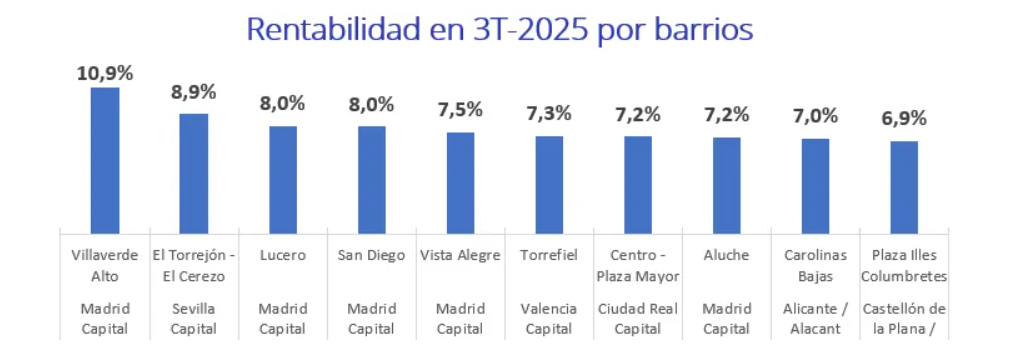
With rental prices hitting record highs in many regions, the margins are growing fastest in areas where buyers can still enter the market at lower price points.
Spain’s top 10 neighbourhoods for rental yield:
- Villaverde Alto (Madrid) – 10.9%
- El Torrejon – El Cerezo (Sevilla) – 8.9%
- Numancia (Madrid) – 8.6%
- Casco Historico (Toledo) – 8.5%
- El Grau (Valencia) – 8.2%
- Lucero (Madrid) – 8.0%
- San Diego (Madrid) – 8.0%
- Alisal – San Roman (Santander) – 7.9%
- Espinardo (Murcia) – 7.6%
- Vista Alegre (Madrid) – 7.5%
What it means for investors
The message is clear: the best returns aren’t in the most expensive postcodes. Investors willing to look at the outer edges of big cities or secondary markets are finding stronger yields and faster rental uptake.
And with inflation still a concern, bricks and mortar remains a popular hedge for cash-rich buyers looking for security and long-term growth.
Full list of top-performing neighbourhoods for rental return (Q3 2025):
- Villaverde Alto (Madrid) – 10.9%
- El Torrejon – El Cerezo (Sevilla) – 8.9%
- Numancia (Madrid) – 8.6%
- Casco Historico (Toledo) – 8.5%
- El Grau (Valencia) – 8.2%
- Lucero (Madrid) – 8.0%
- San Diego (Madrid) – 8.0%
- Alisal – San Roman (Santander) – 7.9%
- Espinardo (Murcia) – 7.6%
- Vista Alegre (Madrid) – 7.5%
- Torrefiel (Valencia) – 7.3%
- Centro – Plaza Mayor (Ciudad Real) – 7.2%
- Isleta (Las Palmas de Gran Canaria) – 7.2%
- Aluche (Madrid) – 7.2%
- Benicalap (Valencia) – 7.2%
- Milan – Pumarin (Oviedo) – 7.1%
- Barrio Alto – San Felix (Almeria) – 7.1%
- Carolinas Bajas (Alicante) – 7.0%
- La Malva-rosa (Valencia) – 7.0%
All of the above post returns above the national average of 6%. Notably, Espinardo in Murcia jumped two full points in one year, from 5.6% in Q3 2024 to 7.6% now.
Where returns are lowest
At the other end of the scale, nine neighbourhoods posted yields under 3%, mostly in high-end or central urban zones.
Least profitable neighbourhoods (Q3 2025):
- Lista (Madrid) – 2.6%
- Recoletos (Madrid) – 2.6%
- Castellana (Madrid) – 2.6%
- Centro Historico (Malaga) – 2.8%
- Almagro (Madrid) – 2.8%
- Goya (Madrid) – 2.8%
- Area Romantica (San Sebastian) – 2.8%
- Ibiza (Madrid) – 2.9%
- Avda. Federico Garcia Lorca – Nueva Estacion Autobuses (Granada) – 2.9%
These areas are among the most expensive in the country, where high property prices often outpace achievable rental income, a clear warning for yield-focused investors.
Read more Spain property news at the Spanish Eye.