The long-talked-about dream of a railway running the length of the Costa del Sol is inching closer.
In June this year, Spain’s Ministry of Transport awarded a €991,911 contract to draft the line’s long-awaited feasibility study.
The proposed 195-kilometre ‘Tren Litoral’ would connect Algeciras in Cadiz to Nerja in Malaga, serving Estepona, Marbella, Fuengirola and Malaga city along the way – and potentially extending to other towns such as La Linea de la Concepcion, which is pushing hard to be included.
A corridor under pressure
The AP-7 and A-7 roads linking these towns are among the most congested in southern Spain. Motorists from the Campo de Gibraltar face tolls of up to €38 just to reach Málaga and back, making the lack of a rail alternative increasingly unsustainable.
If approved, the railway would also connect the Campo directly to Malaga Airport, Spain’s fourth busiest.
Five major sections
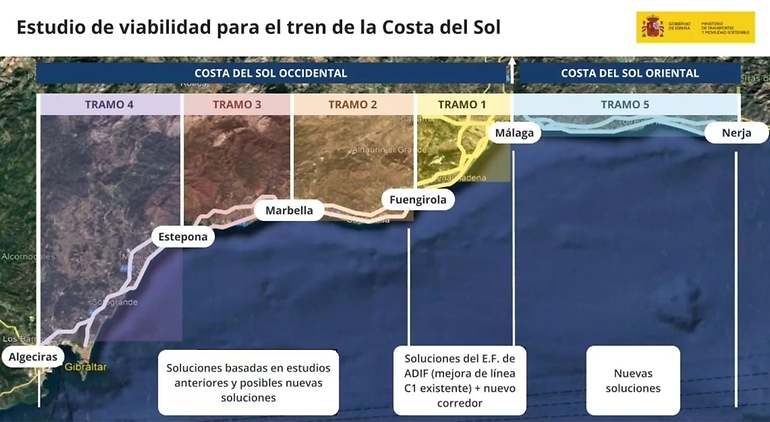
The feasibility study, expected to take 18 months, divides the project into five phases:
- Malaga–Fuengirola
- Fuengirola–Marbella
- Marbella–Estepona
- Estepona–Algeciras
- Malaga–Nerja
Each stretch would then be tackled separately, with construction estimated at around two years per section.
But with environmental approvals, expropriations and financing still hurdles, experts warn the full line could take up to 16 years to complete. The quickest estimate is around 11 years.
Eye-watering costs
At between €40–60 million per kilometre, the line could cost around €6.7 billion in total.
A previous plan drawn up by Malaga city council and Unicaja only extended as far as Marbella, with a budget of €2.1 billion. National contractors’ group Seopan now pegs the full coast-to-coast project at just under €6.7 billion.
La Linea fights its corner
One of the loudest demands has come from La Linea mayor Juan Franco, who has asked for an urgent meeting with transport minister Oscar Puente to ensure his town – and Gibraltar, with which it shares a border and over 100,000 residents – is not left off the map.
Still a long way off
Even in the best-case scenario, the feasibility study must be followed by another 18-month “informative” study, then environmental declarations that could drag on for years.
That means the first train won’t run until the 2040s at the earliest – if Spain’s political will, financing and bureaucracy don’t derail it first.
Read more Andalucia news at the Spanish Eye.