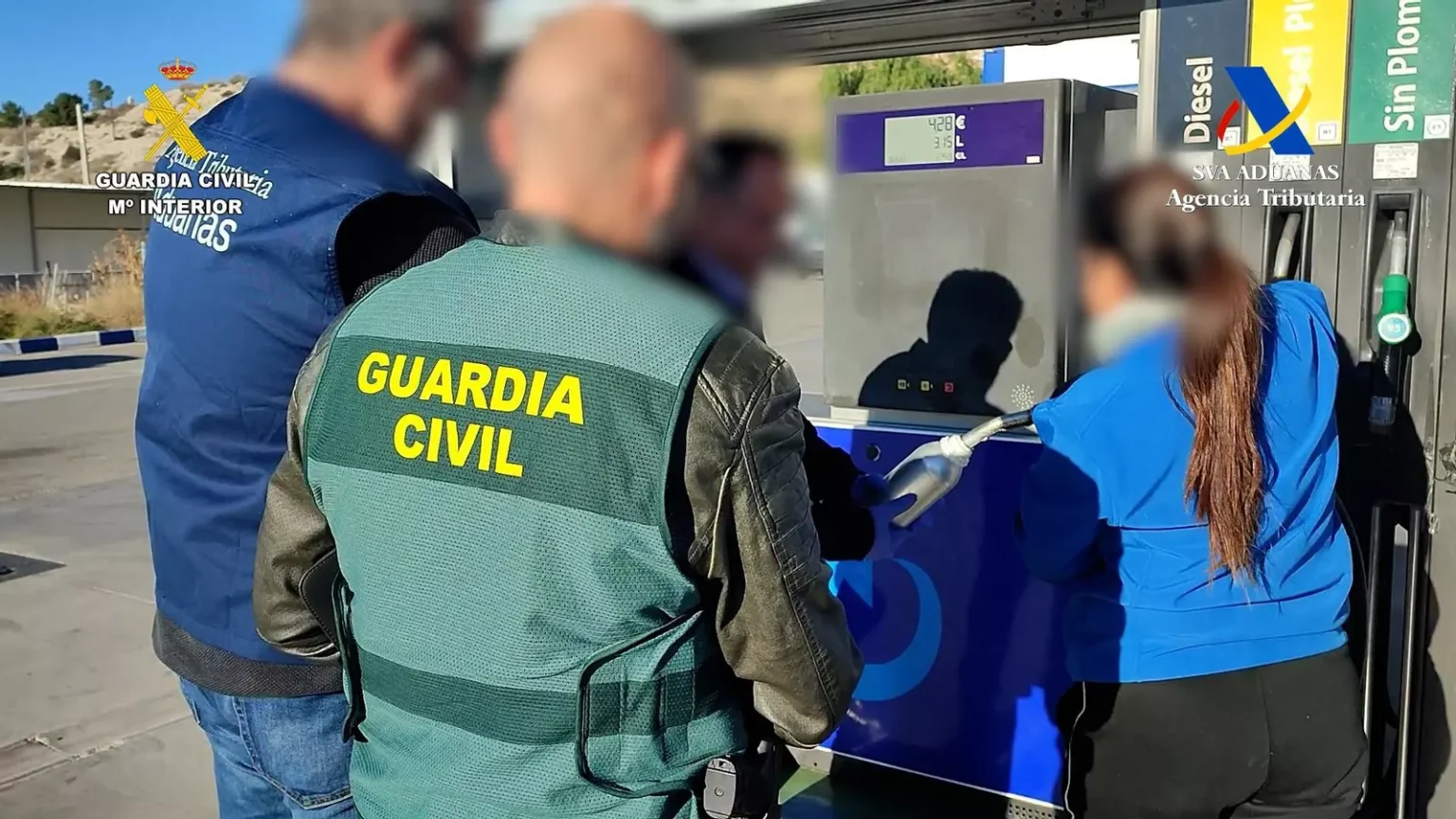

A major yearslong investigation has revealed how criminal networks sent adulterated fuel to petrol stations across Spain, including in Andalucia.
The Guardia Civil and Spain’s Customs Surveillance Service said the group sent adulterated fuel to low-cost petrol stations in Almería, Murcia, Alicante and Valencia as part of a large-scale tax evasion scheme.
The two-year investigation, codenamed Operation Tenk, has led to 18 arrests, 14 further suspects under investigation and links to 40 companies allegedly tied to the racket.
How it began
The case was triggered in 2023 when residents of La Hoya del Campo in Abaran (Murcia) complained about the constant movement of tanker lorries.
Local patrols uncovered an illegal fuel depot containing more than 70,000 litres of diesel, as well as machinery and storage tanks.
The substance turned out to be so-called ‘designer fuel’ – a mix of diesel and other components added to alter its physical properties and avoid paying taxes. Investigators also seized triacetin, a chemical not approved for automotive diesel.
The modified fuel was destined for ‘low-cost’ service stations across Murcia, Almeria, Alicante and Valencia. Further raids uncovered two more illegal depots in Abanilla (Murcia) and Silla (Valencia).
Imported and declared as lubricants
Authorities discovered that the fuel originated from Latvia, Poland, Slovakia, Hungary and Lithuania. To dodge customs checks and excise duties, the shipments were fraudulently declared as oils and lubricants rather than diesel.
By doing so, the network avoided Spain’s Special Hydrocarbons Tax, as well as VAT and corporation tax obligations. Officials say the scheme not only defrauded state coffers but also created unfair competition for legitimate businesses.
Risks to drivers and the public
The adulterated fuel poses multiple dangers. Firstly, emissions from burning the fuel could threaten public health.
Secondly, irregular depots carried spill and fire risks, while engines could be harmed by the poor-quality mixture, leaving unsuspecting drivers out of pocket.
A complex web of front companies
The network operated through shell companies created under the names of so-called ‘front men’.
These individuals, in precarious financial situations, lent their identities in exchange for payment. Many were foreign nationals, including Ukrainians, Latvians and French citizens, as well as Spaniards.
Altogether, 40 firms across Murcia, Almería, Alicante, Albacete, Barcelona, Valencia, Madrid, Girona, Lleida and Tarragona were linked to the operation.
Charges and offences
Those arrested face charges including fraud, document forgery, tax evasion, Social Security fraud, money laundering, road safety offences and belonging to a criminal organisation.
One lorry driver alone has been charged with 26 separate road safety offences after transporting hazardous cargo without a valid licence.
Investigators have so far inspected 11 petrol stations and companies connected to the network, with more action expected as the probe continues.
Read more Andalucia news at the Spanish Eye.